


Sleep elevated on an extra pillow, take a pain reliever exactly as directed, apply a cold compress to the outside of your cheek, and gently rinse with warm salt water. Never put aspirin on your gums. If you experience facial swelling, fever, or difficulty swallowing, call 112 tonight.
The rest of this page elaborates on these actions, and especially the signs that indicate that you should not wait until morning.
Why does toothache worsen at night?
Two things change when you lie down.
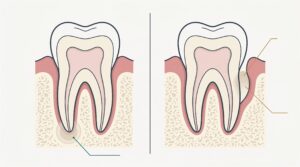
Blood pressure increases slightly in the head when lying horizontally. Inside a tooth, the pulp, that is, the central neurovascular bundle, occupies a rigid chamber with no possibility of expansion. If this tissue is already inflamed, the additional pressure has nowhere to go, and you feel it as throbbing.
The second reason is simpler: during the day, you are busy. At night, nothing distracts you from the pain.
Pain that regularly wakes you up has clinical value. It generally indicates that the pulp is inflamed or dying, rather than simple sensitivity, and points towards root canal treatment rather than a filling.
This provides real relief until morning
- Elevate your head. Add one or two extra pillows, keeping your head above your heart. This is the most effective measure on this list and it costs nothing.
- Take a pain reliever according to the instructions. Anti-inflammatories are generally more effective than paracetamol alone for dental pain, as dental pain is inflammatory. Only take them if they are suitable for you: read the instructions and ask your pharmacist for advice if you are taking other medications.
- Apply cold to the outside of your face for twenty minutes, then take a twenty-minute break. Never apply ice directly to the skin, and never place it inside your mouth against your teeth.
- Rinse with warm salted water , a teaspoon in a glass, gently, then spit out.
- Keep the area clean. Continue brushing gently, even if it’s sensitive. Debris trapped in a cavity will worsen the pain.
- Avoid triggers: heat, cold, sweets, hard foods. Chew on the other side.
These measures don’t cure anything. They just give you a temporary reprieve. The French Union for Oral Health reminds everyone that no home treatment can replace addressing the underlying cause.
What you absolutely must not do
Don’t place an aspirin tablet against your gum. This is the most common piece of bad advice. Aspirin is acidic and burns the soft tissue it rests on, producing a painful white chemical burn on top of your existing toothache. Pain relievers work through the bloodstream: swallow them.
Do not apply heat to the face. A hot compress provides relief for a few minutes but can actually promote the spread of infection into the tissues. Use cold, not heat.
Don’t rely on clove oil. It provides brief numbing relief, irritates the gums with repeated use, and does not address the underlying cause.
Never attempt to drain it yourself. Do not puncture a swelling with a needle or anything else: you would only introduce more bacteria into an already infected area.
Don’t consider the cessation of pain as a cure. A toothache that disappears abruptly, especially after intense throbbing, often means the nerve has died. The infection, however, continues. Seek medical help anyway. We explain this phenomenon in detail in our guide to dental emergencies in Luxembourg .
When you shouldn’t wait until morning
Most toothaches can wait a few hours. Not these.
Call 112 or go to the emergency room tonight if you experience:
- Swelling extending towards the eye or down the neck
- Difficulty swallowing, or the slightest difficulty breathing
- Fever or chills accompanied by facial swelling
- The inability to open the mouth properly
- The swelling is visibly worsening by the hour.
- Confusion or a severely altered general condition
These signs suggest an infection that has spread beyond the tooth to the soft tissues of the face and neck. It’s uncommon, it’s serious, and it doesn’t go unnoticed. The French National Health Insurance ( Assurance Maladie) provides a detailed description of these signs of spread .
This is probably what’s causing your pain.
| What you feel | Probable cause |
|---|---|
| Sharp pain triggered by cold or sweets, which subsides within seconds | Early caries, exposed dentin, worn filling |
| Pain that persists for several minutes after heat or cold | Inflamed pulp, often requiring root canal treatment |
| Constant heartbeats, worse when lying down, tooth “higher” | Dying or dead pulp, possible abscess |
| Sharp pain upon release of the bite | Cracked tooth |
| Dull pain in several teeth, worse upon waking | Bruxism, nighttime clenching |
| Red and bleeding gum around a single tooth | Periodontal infection |
This chart provides guidance, but it does not diagnose. Dental pain is very difficult to pinpoint: the upper and lower teeth on the same side share nerve pathways, and patients frequently point to the wrong tooth. This is why an examination, and most often an X-ray, is necessary. The FDI World Dental Federation emphasizes this point in its recommendations to patients.
When to consult
Make an appointment if the pain woke you up, if it lasts for more than a day or two, if there is any swelling, or if it returns despite periods of relief. Intermittent pain is a classic pattern of worsening, not healing.
Come even if things have calmed down by the time of your appointment. The silence of a tooth that was screaming the day before is information, and rarely good information. Our prevention page explains what a check-up can detect before this stage.
Related questions
If the pain is accompanied by swelling, also read how to recognize a dental abscess .
Les urgences hospitalières prennent en charge les infections diffusées, les gonflements importants, les saignements incontrôlables et les traumatismes du visage. Une rage de dent sans ces signes relève du dentiste ou du service de garde dentaire, mieux équipé pour traiter la dent elle-même. Les antibiotiques traitent l'infection, pas la cause. Ils peuvent réduire le gonflement et la douleur, mais la dent doit être traitée, généralement par traitement canalaire ou extraction. Ils sont prescrits en cas de signes de diffusion, pas systématiquement pour une douleur dentaire. Une douleur intermittente traduit souvent une pulpe enflammée mais pas encore nécrosée, qui s'emballe à la moindre irritation puis se calme. C'est un schéma de dégradation, pas de récupération. Les périodes calmes ne sont pas une guérison.
Call as soon as we open
We reserve emergency slots every day at both of our clinics. Please call as soon as possible: this gives us the best chance of seeing you the same day.
TalpaDent, 71 Rue de Luxembourg, L-8440 Steinfort and 55-57 Av. Pasteur, L-2311 Limpertsberg . Call +352 20 29 64 00 or make an appointment .
This article provides general information and is not a substitute for a professional dental examination. If you experience facial swelling, fever, or difficulty breathing or swallowing, call 112 immediately. Follow the dosage instructions on the package insert for any medication and consult your pharmacist if you are taking other treatments.

Dr. Talpa is a licensed dentist with 12 years of clinical experience and owner of Advanced Smile Dental Care. Dedicated to making dental health information accessible, Dr. Talpa writes to help readers make informed decisions about their oral care. With a background in general and cosmetic dentistry, Dr. Talpa is passionate about translating complex dental topics into practical advice. When not treating patients, Dr. Talpa enjoys staying current with the latest advances in dental science and technology.