

Keep the crown if you have one: if it’s intact, it can often be re-cemented for a fraction of the cost of a replacement. Keep the area clean, avoid chewing on that side, and use a temporary dental cement from the pharmacy. Never use DIY glue. See a dentist within a few days, sooner if the tooth is sensitive.
The following explains why the time frame matters more than the pain.
Is it urgent?
Generally not. A lost filling or crown without pain is bothersome and worrying, but it is not a same-day emergency like facial swelling.
Get a faster consultation if:
- The tooth is extremely sensitive to air, cold, or sweets, suggesting exposed dentin or pulp.
- A sharp edge injures the tongue or cheek
- There is pain when chewing.
- The crown came out with a piece of tooth stuck inside.
- You have swelling, a bad taste, or shooting pains.
This last point completely changes the situation: refer to our article on the signs of a dental abscess .
If you have lost a crown
Find it and keep it. That’s the key. An intact crown, placed on a still-healthy tooth, can very often simply be re-cemented. It’s a quick appointment and a small fraction of the cost of a replacement. A discarded, chewed, or glued crown requires starting all over again: new preparation, a new impression, and lab work. The CNS renewal period also applies, as fixed prostheses are only covered every twelve years.
What to do :
- Rinse it gently with cold water and store it in a safe place. In a small box, not loose in a pocket.
- Look inside. If it’s hollow and clean, the tooth underneath is probably intact. If there’s a fragment of tooth embedded inside, the tooth has fractured and the crown cannot simply be replaced.
- Keep the exposed tooth clean. Brush it gently; it will feel strange to the touch and may be sensitive.
- Use a temporary dental cement from the pharmacy if you wish to reattach it in the meantime. Follow the instructions, and only if it fits completely and without forcing.
- Do not chew on this side and avoid anything sticky.
- Bring the crown to the appointment. Even if damaged, it is useful: it indicates the shape and color to be reproduced.
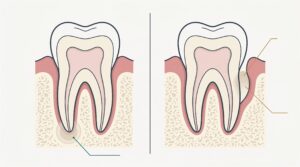
A crown never falls out for no reason. Sometimes the cement has simply worn down after years, and that’s the correct scenario. More often, decay has developed underneath, at the joint, and has surreptitiously loosened it. That’s why we wouldn’t re-cement without examination: placing a dental crown over active decay is like sealing the problem in.
If you have lost a filling
Fillings fail for the same reasons: age, fracture, or recurrent decay at the edges.
Keep the cavity clean and rinse with warm salted water after meals. Food packed into an open cavity can turn a painless situation into a painful one within days. A temporary cement will protect it in the meantime.
There is no point in keeping the old filling: unlike a crown, it cannot be reused.
Consult within the week. An open cavity is a direct route for bacteria to the deeper layers of the tooth, and the progression is faster than you might imagine: a simple adhesive filling in one week can become a root canal treatment in a few months.
Things you should never use
Never re-cement a crown with superglue. This is the most common way to turn a re-cementable crown into an unsalvageable one. Cyanoacrylate is not biocompatible, is not designed for humid environments, does not remove cleanly from the inner surface, and frequently sets with the crown slightly crooked, which throws off the bite and can damage the opposing tooth.
Also to be avoided: chewing gum as a temporary filling, prosthesis glue on a crown, and any attempt to file down a sharp edge yourself.
Temporary dental cement sold in pharmacies specifically for this purpose is suitable, when used according to the instructions, for a few days. It is not a long-term solution and does not replace a consultation. The FDI World Dental Federation warns against improvising dental repairs at home.
What it will cost
Shaving an intact crown is a minor procedure. Replacing one is not: it requires laboratory work and several sessions.
According to the rules of the National Health Insurance Fund , dental prostheses are reimbursed at 80% of the official rates, a rate increased to 100% if you have had a preventative dental checkup in each of the two calendar years preceding the fitting. Fixed prostheses are renewable every twelve years, so a crown replaced early in this cycle may not be covered as a new procedure.
This is the strongest practical argument for storing the wreath in a box rather than losing it down the sink.
When to consult
Schedule an appointment within a few days for a painless filling or crown replacement. Schedule it sooner if the tooth is sensitive, if there’s a sharp edge, if there’s pain when biting, or if the crown came out with a piece of tooth.
Bring the crown in. Bring it in even if it looks broken. Regular checkups, as explained on our prevention page , usually allow you to spot a crown that’s loose before it falls out.
Related questions
For other urgent situations, consult our guide on dental emergencies in Luxembourg .
Non. Le ciment temporaire de pharmacie tient quelques jours, ce qui est utile, mais ce n'est pas un scellement définitif et cela ne règle pas la raison pour laquelle la couronne est tombée. La dent dessous doit être examinée avant tout scellement. Quelques jours, raisonnablement ; plusieurs semaines, non. Une cavité ouverte laisse les bactéries atteindre les couches profondes, et ce qui aurait été une simple réobturation peut évoluer vers un traitement canalaire. Attendre n'apporte aucun bénéfice. Généralement pour l'une de trois raisons : le ciment a fatigué au fil des années, une carie s'est développée au niveau du joint et l'a décollée, ou la dent dessous a fracturé. Seuls un examen et le plus souvent une radiographie permettent de savoir laquelle, et la réponse détermine si elle peut simplement être remise.
Bring the crown with you
If you still have it and it’s intact, there’s a good chance we can reseal it. Give us a call and we’ll find a time slot for you in the next few days.
TalpaDent, 71 Rue de Luxembourg, L-8440 Steinfort and 55-57 Av. Pasteur, L-2311 Limpertsberg . Call +352 20 29 64 00 or make an appointment online .
This article provides general information and is not a substitute for a personalized dental examination. If you experience swelling, fever, or severe pain, consult a dentist promptly. Only use temporary dental cement from the pharmacy as directed on the label.

Dr. Talpa is a licensed dentist with 12 years of clinical experience and owner of Advanced Smile Dental Care. Dedicated to making dental health information accessible, Dr. Talpa writes to help readers make informed decisions about their oral care. With a background in general and cosmetic dentistry, Dr. Talpa is passionate about translating complex dental topics into practical advice. When not treating patients, Dr. Talpa enjoys staying current with the latest advances in dental science and technology.