

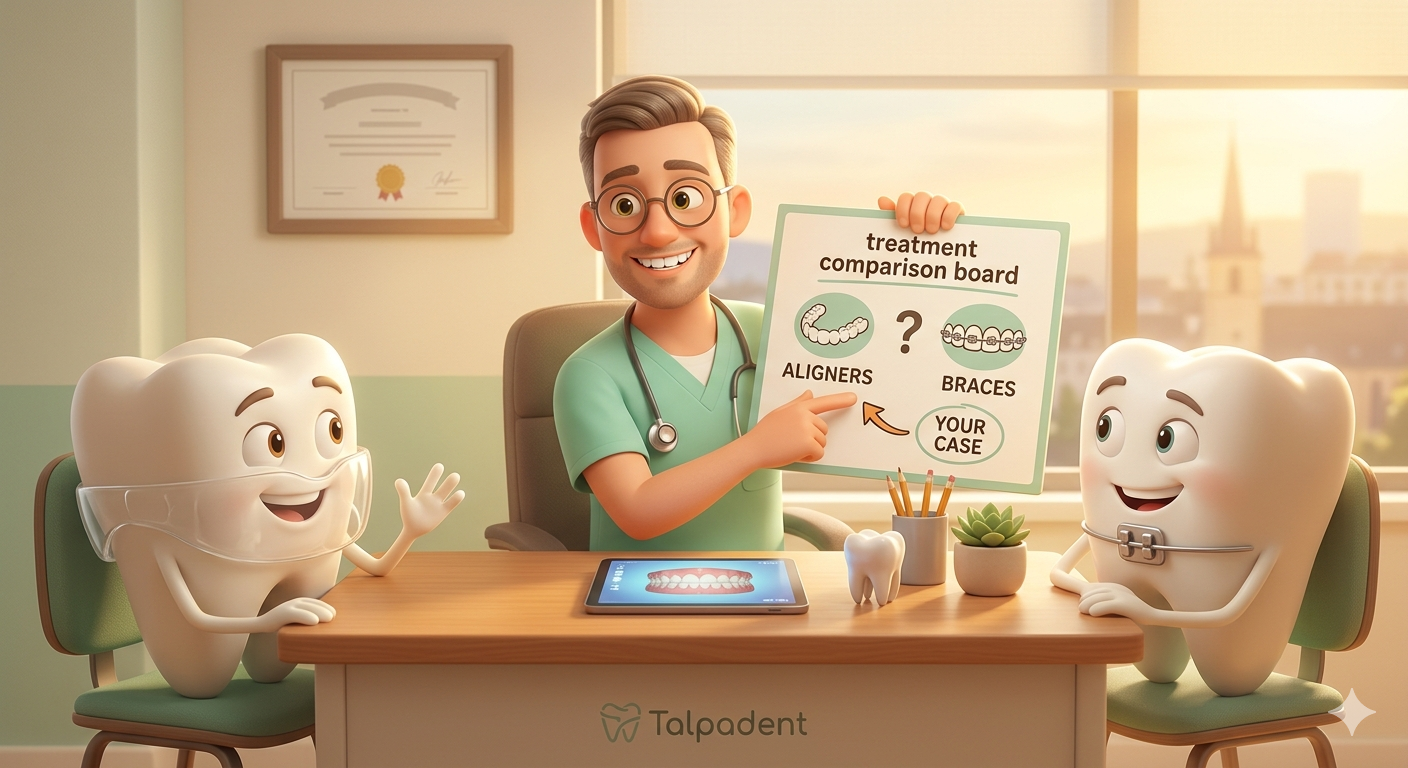
Invisalign is better than braces for some people and worse for others. It comes down to two things: how complex your teeth are, and how consistently you will wear the aligners every day. For mild to moderate straightening, Invisalign works just as well as braces and brings real advantages for comfort, appearance, and hygiene. For more complex problems like severe crowding, significant bite issues, or heavily rotated teeth, braces tend to give more reliable and complete results. There is no single right answer that works for everyone, which is why a proper dental assessment matters more than any online comparison.
What each treatment does in simple terms
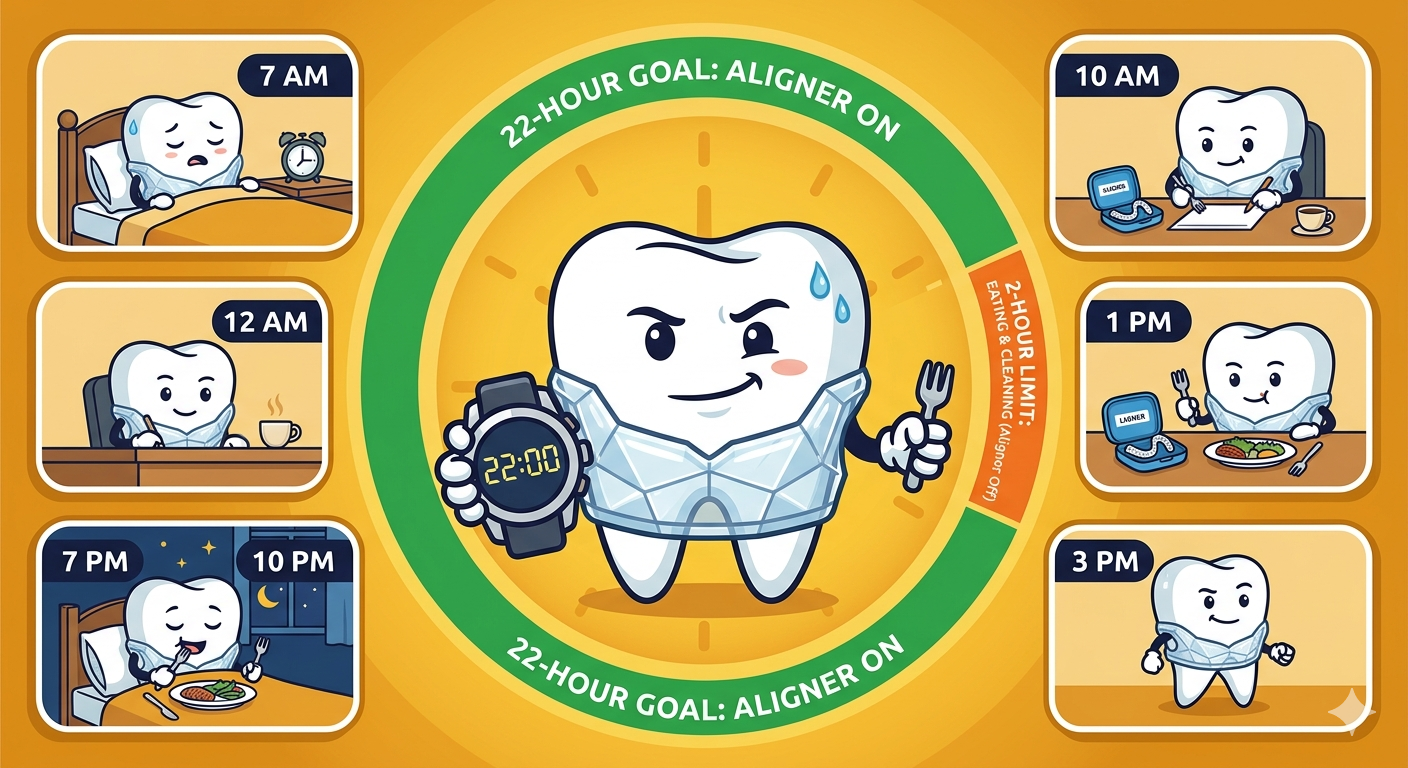
Invisalign uses a series of clear plastic trays made from a smooth medical-grade material. Each tray fits precisely over your teeth and applies controlled pressure to move them gradually. You swap to a new tray every one to two weeks. The aligners come out for eating, drinking anything other than water, and cleaning your teeth. They need to be back in for at least 20 to 22 hours every day to keep the treatment on track.
Traditional braces use metal or ceramic brackets bonded to the front of each tooth, connected by a thin wire. The wire creates continuous pressure across your teeth and moves them along a planned path. Your orthodontist adjusts the wire tension at appointments every four to six weeks. Because braces are fixed to your teeth, they work continuously with no input from you.
According to the NHS guide on orthodontic treatment, fixed braces are generally recommended for more complex cases while removable aligners are better suited to mild and moderate alignment needs. Both treatments take roughly one to two years depending on how much movement your teeth actually need.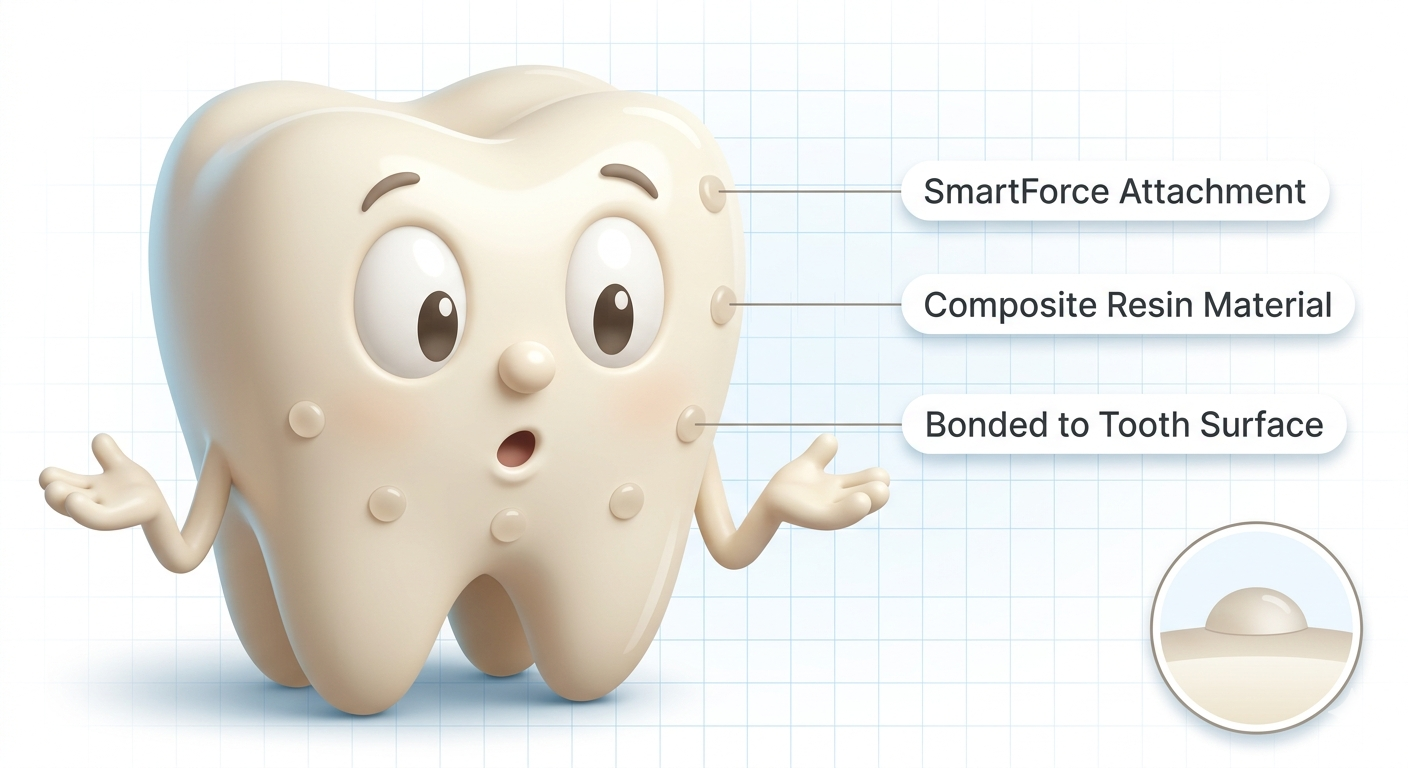
Invisalign vs braces: comparing what actually matters
Which looks better – Invisalign or braces?
Invisalign wins on appearance. The clear trays are practically invisible at normal speaking distance. Most people around you will not notice them during a conversation or a meeting. This matters a lot to adults who are already in professional environments and to teenagers who do not want to go through school with metal brackets on their teeth. Metal braces are visible and noticeable throughout treatment, which for many patients lasts 18 months or more. Ceramic braces use tooth-coloured brackets and look better than metal, but they are still more visible than clear aligners.
One thing worth knowing: many Invisalign patients also need small tooth-coloured resin dots called attachments bonded to specific teeth to help the trays grip properly. These make the aligners slightly more visible than the marketing photos suggest. Not every patient needs them, but for moderate to complex cases they are common. We cover this in more detail below. At Talpadent’s orthodontic service, we go through all visible and invisible treatment options before making any recommendation, because the choice you feel comfortable with is one you will actually stick with.
Which is more comfortable – Invisalign or braces?
Clear aligners are generally more comfortable day to day. The smooth plastic does not irritate your inner cheeks or gums the way metal brackets and wires can. There is no risk of a wire snapping or a bracket coming loose and scratching your mouth, which is a real occurrence during braces treatment. When you switch to a new tray, some pressure and mild soreness are normal for the first day or two, then it fades.
A clinical study comparing Invisalign and fixed appliance patients found that aligner patients reported significantly less pain during the first week of treatment. After a braces wire adjustment, soreness can last two to four days and tends to be more intense than the aligner equivalent. For patients with lower pain tolerance, this difference matters over a treatment period that can last one to two years.
Which gives better results – Invisalign or braces?
For mild to moderate cases, both treatments produce equivalent results. The difference appears in complex situations. A 2024 study that followed 200 orthodontic patients over five years found that both treatments effectively improved dental alignment and that results were comparable at the five-year mark. The success rate for traditional braces was approximately 90 percent compared to 88 percent for Invisalign. That two-point difference is small for routine cases. Where it becomes meaningful is in complexity, particularly for rotating teeth, vertical tooth shifts, and significant bite corrections where braces apply a level of three-dimensional mechanical force that plastic trays cannot fully replicate.
A 2025 randomised controlled trial found that for complex cases specifically, braces patients finished treatment an average of 4.8 months sooner than Invisalign patients. For straightforward cases, Invisalign is typically faster. The type of case is what determines which has the advantage.
Is Invisalign faster than braces?
For mild to moderate cases with full compliance, yes. Current clinical data consistently show Invisalign taking 12 to 18 months for these cases compared to 18 to 24 months for braces at similar complexity. For complex cases, the advantage flips. The 2025 trial data mentioned above found braces finishing 4.8 months faster for complex corrections.
The treatment time for Invisalign also depends heavily on daily wear consistency. A patient who wears their trays for 22 hours a day stays on schedule. A patient who regularly falls short of that extends the treatment, sometimes significantly. Braces finish on a timeline controlled entirely by the orthodontist through wire adjustments, not by patient behaviour. At Talpadent we use advanced 2D and 3D dental imaging to plan every stage of treatment before it starts, giving patients an accurate time estimate from day one based on what their teeth actually need.
Is Invisalign more expensive than braces?
Historically, Invisalign has been slightly more expensive due to the digital scanning and custom tray manufacturing process. That gap has narrowed as the technology has become more widespread. For mild cases, costs are often comparable. For complex cases requiring many aligner trays and potentially multiple refinement rounds, the total cost with Invisalign can exceed equivalent braces treatment.
The American Association of Orthodontists recommends getting a full clinical assessment before comparing costs, because case complexity is the main driver of total treatment price regardless of which method is used. Both treatments may be partially covered by dental insurance plans with orthodontic benefits. The most accurate number for your situation will come from a consultation where your teeth can be properly assessed.
Which is easier to keep clean – Invisalign or braces?
Invisalign is significantly easier to maintain. You remove the trays, brush and floss normally, clean the trays, and put them back in. Nothing is fixed to your teeth, so your standard oral hygiene routine works without modification. Clinical research comparing patients in Invisalign and fixed braces consistently shows that aligner patients maintain lower plaque levels and better gum health during treatment because cleaning is simpler. A cross-sectional study by Azaripour et al. found significantly better gingival health scores in the Invisalign group compared to patients in fixed appliances.
With braces, food regularly gets caught around brackets and under wires. Thorough cleaning needs interdental brushes, floss threaders, and considerably more time than a standard brushing session. Patients who struggle to maintain this routine during treatment are at higher risk of developing decay around the brackets or early gum problems. Our preventive dentistry team at Talpadent monitors gum health throughout any orthodontic treatment and provides specific hygiene guidance tailored to whichever method you are using.
Which has fewer restrictions on diet and daily life?
Invisalign has no food restrictions at all. You take the aligners out before eating and drinking, eat whatever you want, clean your teeth, and put the aligners back in. Hard foods, sticky foods, crunchy vegetables, anything at all is fine. With braces, you need to avoid anything that could break a bracket or bend the wire for the entire treatment period. This typically means no hard sweets, no toffee or chewing gum, no crunchy raw vegetables, and care with crusty bread or chewy foods. For most people this is manageable, but over a two-year treatment it is a genuine adjustment that affects everyday choices at every meal.
Something most guides do not mention: Invisalign attachments
Here is something the vast majority of Invisalign comparison guides leave out completely, and that surprises patients when they arrive for their first fitting appointment.
Many Invisalign patients need small tooth-coloured bumps called SmartForce attachments, sometimes called buttons, bonded onto specific teeth before treatment begins. These attachments are tiny shapes made from composite resin, the same tooth-coloured material used for fillings, bonded to the surface of selected teeth. They act as anchor points that give the aligner trays something to push against, allowing more precise and complex tooth movements than the tray alone could achieve.
Not every Invisalign patient needs them. For mild crowding or simple spacing issues, aligners often work without any attachments. For more complex movements, rotating a tooth, shifting a tooth vertically, or making changes at the root level, attachments are typically part of the treatment plan.
What patients should know before choosing Invisalign is this: if your treatment requires attachments, the aligners will be slightly more noticeable than the standard marketing images suggest. The dots are tooth-coloured and small, but they are visible up close, particularly on upper front teeth. They stay on throughout treatment and are polished off cleanly once the final tray is complete. This does not make Invisalign a worse option. It just means patients who expect a completely invisible treatment should have an honest conversation with their orthodontist about whether attachments will be part of their specific plan.
Side by side: Invisalign vs braces at a glance
| Factor | Invisalign | Traditional Braces |
|---|---|---|
| Visibility | Nearly invisible (attachments may add some visibility) | Clearly visible metal or ceramic options available |
| Removable | Yes out for eating, drinking and cleaning | No – fixed for the full treatment period |
| Comfort | Smoother no wires or brackets to irritate soft tissue | Can irritate cheeks and gums, especially after adjustments |
| Food restrictions | None remove before eating | Avoid hard, sticky and crunchy foods |
| Oral hygiene | Normal routine brush and floss without modification | Needs interdental brushes and floss threaders |
| Clinical success rate | 88% (2024 five-year study) | 90% (2024 five-year study) |
| Best for | Mild to moderate cases | Complex cases severe crowding, bite corrections |
| Average time mild cases | 12 to 18 months (with consistent wear) | 18 to 24 months |
| Average time complex cases | Longer braces finish an avg. 4.8 months sooner (2025 RCT) | Faster and more predictable for complex corrections |
| Compliance required | High 20 to 22 hours per day, every day | None needed treatment is continuous and automatic |
| Retainer needed after | Yes | Yes |
When Invisalign is the better choice
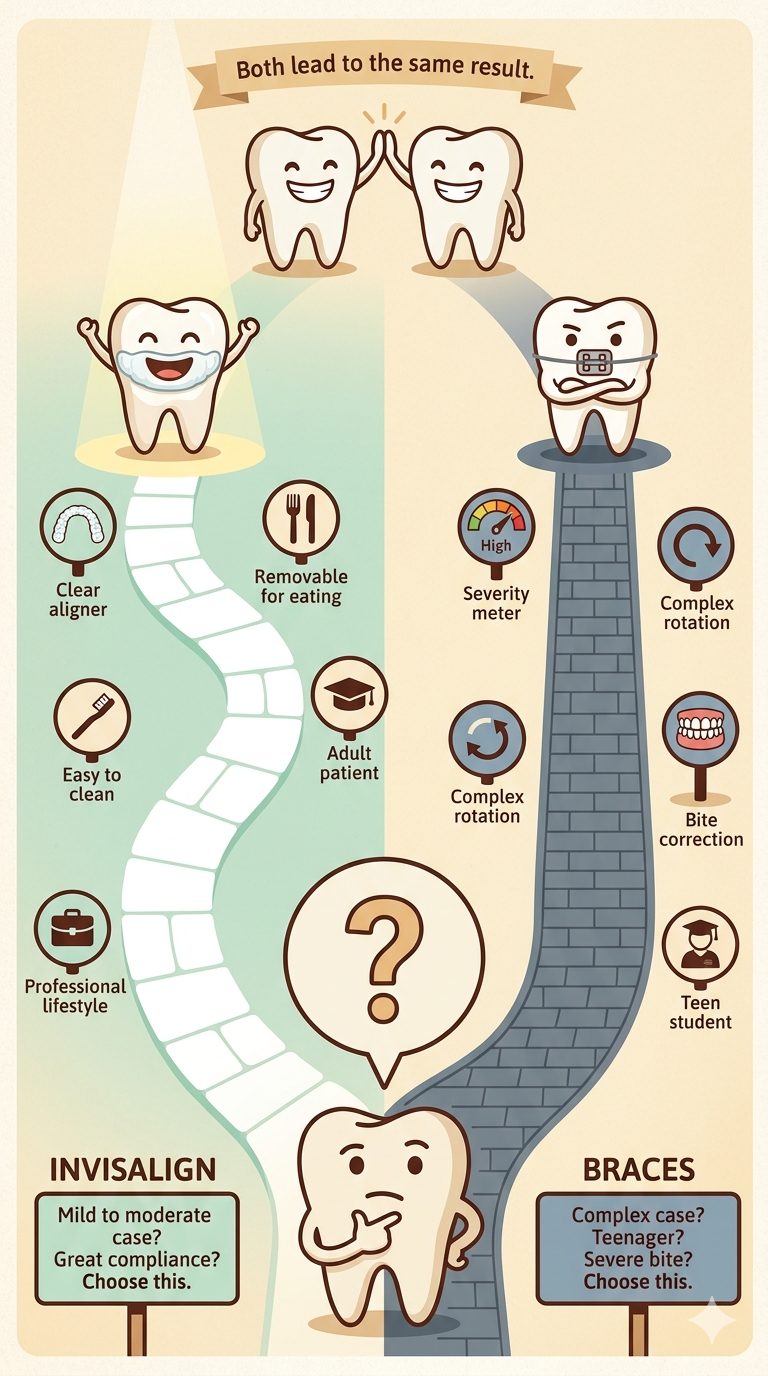
Invisalign tends to be the stronger recommendation when your case is mild to moderate and both treatments would reach the same clinical result anyway. In that situation, the advantages of clear aligners aesthetics, comfort, removability and easier hygiene are real and worth choosing.
It is also well suited for adults with consistent daily routines who will genuinely wear the trays for the required hours. The AAO’s 2025 patient census recorded 1.91 million adults in active orthodontic treatment in the United States, with one in three orthodontic patients today being an adult. Most of them cite appearance and lifestyle flexibility as the main reasons for choosing clear aligners over braces.
People with existing gum sensitivity or a history of gum disease are often better candidates for Invisalign too, simply because maintaining oral hygiene around a fixed appliance is harder. Athletes, musicians who play wind instruments, and anyone who regularly speaks in public or attends client-facing events often find the removability of Invisalign a practical daily advantage that genuinely improves their quality of life during treatment.
When traditional braces are the better choice
Braces are the better clinical option when the case is genuinely complex. Severe crowding, large overbite or underbite corrections, significant tooth rotations, and cases needing controlled vertical tooth movement all respond more reliably to fixed appliances. Braces apply continuous, precise, three-dimensional force and give the orthodontist direct mechanical control over movements that aligner trays struggle to replicate as accurately.
They are also the better option for younger teenagers in most cases. The daily discipline required to make Invisalign work is genuinely difficult to maintain at that age. Braces remove that variable completely. The treatment progresses regardless of whether the patient is thinking about it or not.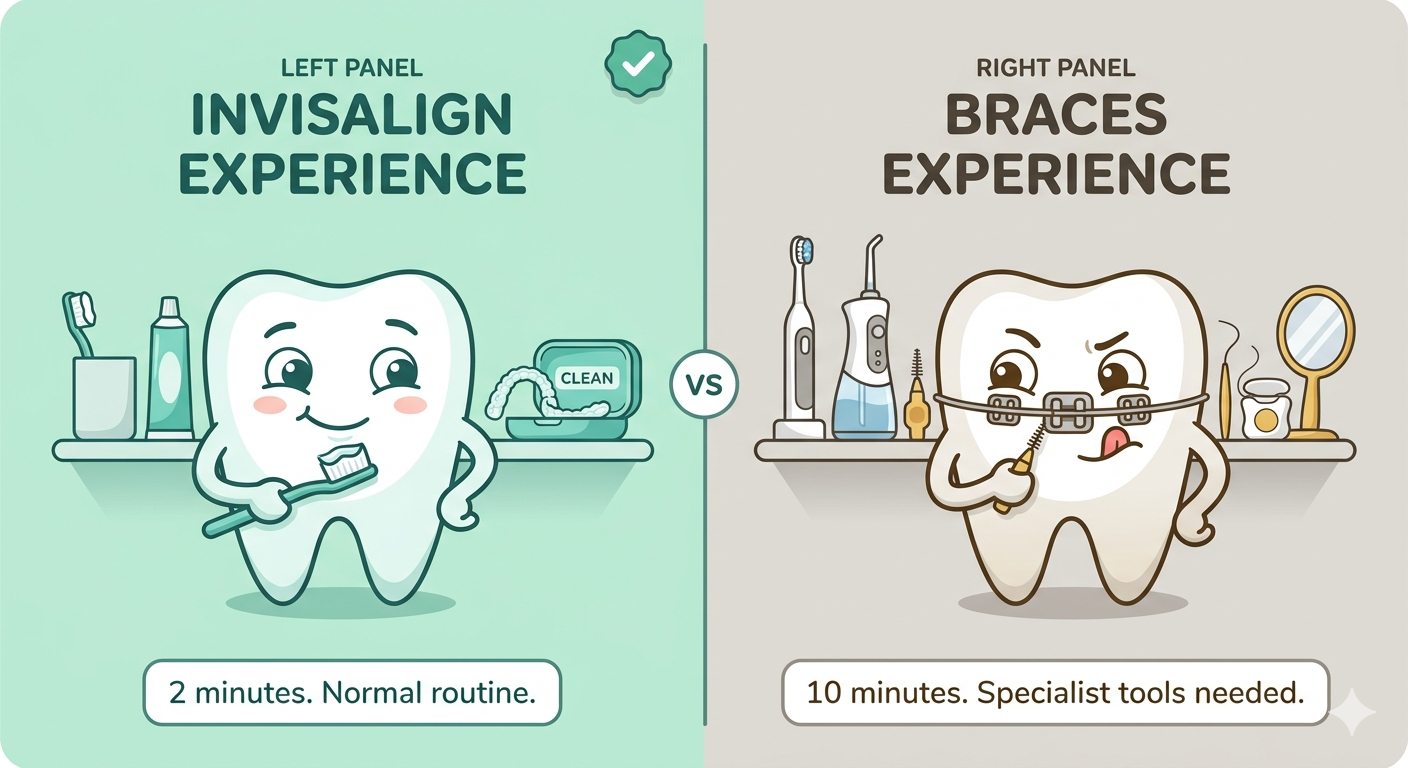
If budget is a priority, metal braces are still the more affordable option in many markets, particularly for complex cases that would require a large number of aligner trays and potentially multiple refinement rounds with Invisalign.
The one thing that determines whether Invisalign works for you
Most comparison guides spend their time on aesthetics and cost. Very few give enough attention to the factor that actually drives whether Invisalign succeeds or falls short: wearing the trays long enough every single day.
The aligners need to be in your mouth for 20 to 22 hours a day. That leaves roughly two hours for meals, drinks, and cleaning your teeth. In practice, this means you cannot take them out after lunch and leave them on the desk for the afternoon. You cannot remove them because a new tray feels tight and leave them out for the evening. Every hour the trays are not in your mouth is an hour your teeth are not receiving the planned movement.
A 2025 systematic review identified patient compliance as the single most influential variable in Invisalign treatment outcomes, ranking above aligner design and attachment configuration. Patients who consistently hit 21 to 22 hours of daily wear finish treatment close to the planned timeline. Patients who average 16 to 18 hours extend their treatment significantly and often need additional refinement trays to complete the intended correction.
This is not a reason to avoid Invisalign. Millions of patients complete it successfully every year. It is, however, the most honest piece of information you need before choosing it. If you know yourself and know that a removable appliance is something you would struggle to keep track of consistently, braces will give you a better result for the same case.
What happens if you lose an Invisalign aligner?
 This is one of the most common practical concerns patients have before choosing Invisalign, and one that almost no comparison guide addresses at all.
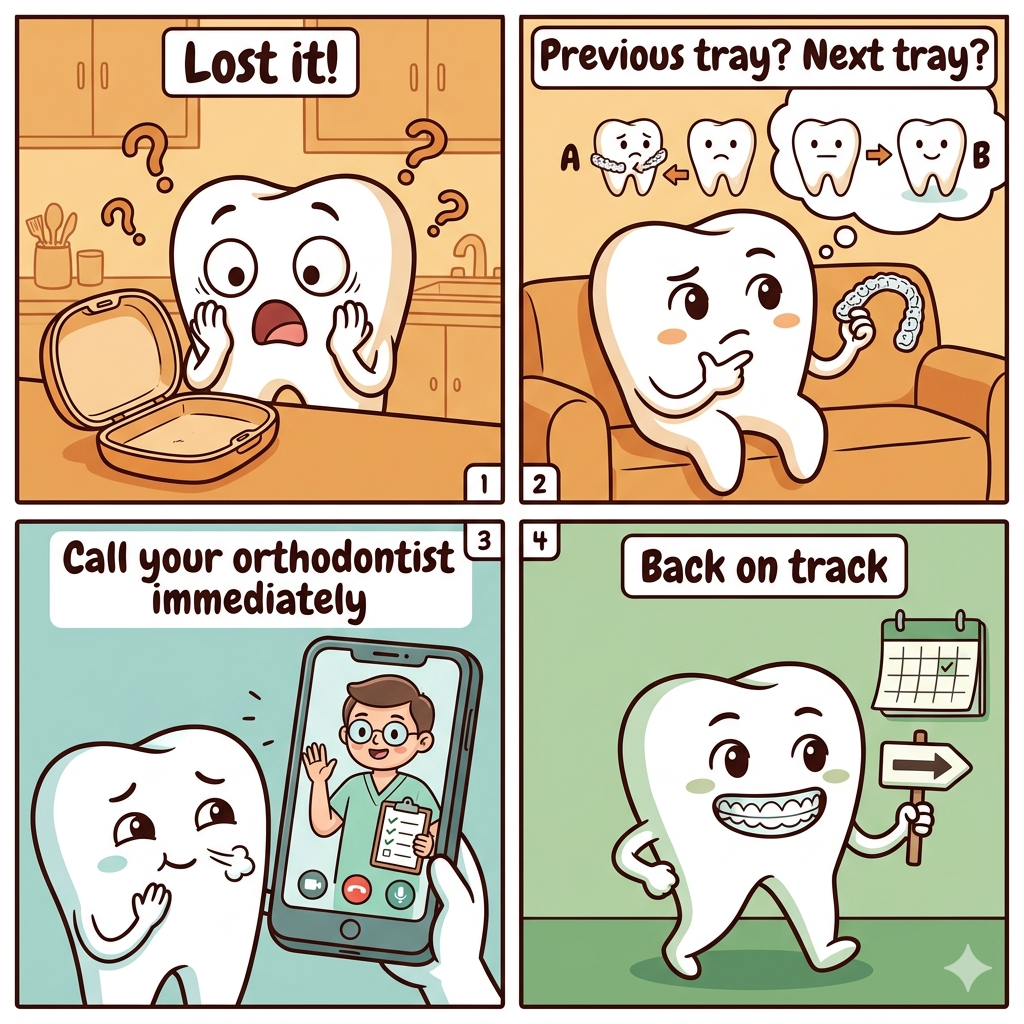
If you lose or damage a tray, the standard approach is to move on to the next tray in the sequence if your teeth are close enough to the expected position, or to go back to the previous tray temporarily until a replacement can be fabricated. Your orthodontist will advise which is appropriate based on how far your teeth have moved and how long you were wearing the lost tray.
Replacement trays can be ordered through your provider, but there is typically a waiting period and sometimes an additional cost depending on your treatment agreement. This is different from losing a braces component. A snapped wire or broken bracket is usually fixed at your next appointment with no replacement cost. Losing an aligner tray is a more disruptive event that requires communication with your provider as soon as possible to avoid the teeth drifting back out of position. If this happens during your treatment at Talpadent, contact our team immediately and we will advise the fastest way to get back on track without losing the progress made.
Ceramic braces and lingual braces: a third option worth knowing
Most guides give you a binary choice. There are actually four main orthodontic options, and two of them are consistently underrepresented in comparison articles.
Ceramic braces work exactly like metal braces but use tooth-coloured brackets that are far less visible than standard metal. They offer the same clinical capability as metal braces for complex cases, with improved aesthetics. They cost a little more than metal, require careful cleaning because ceramic can stain, and are a strong option for patients who need the mechanical advantage of fixed appliances but want a less visible appearance during treatment.
Lingual braces are brackets and wires placed on the inner, tongue-facing surfaces of the teeth, making them completely invisible from the front. They can handle complex cases that Invisalign cannot and are the only fully hidden fixed orthodontic option. They cost more than conventional braces, require an adjustment period for speech, and need a provider trained in their placement. According to the American Dental Association’s orthodontic guidance, the right appliance type should always be selected based on the clinical movements required rather than personal preference alone.
Do you still need retainers after Invisalign and braces?
Yes, after both. This is one of the most consistently overlooked facts in orthodontic care and it surprises many patients who assumed treatment ends when the braces come off or the last aligner tray is complete.
Teeth do not stay in their new positions permanently. The bone and connective tissue around each tooth continue to adapt for months after active treatment ends. Without a retainer during this period and then periodically long term, teeth gradually drift back toward where they started. This process is called relapse and it happens regardless of whether Invisalign or braces moved the teeth.
The standard guidance is full-time retainer wear for the first three to six months after treatment, then nights only for the long term. Many orthodontists now recommend wearing a night retainer indefinitely to protect the result permanently. The retainer phase is not a complication or a failure. It is simply the final stage of straightening your teeth. Our preventive care team at Talpadent covers retainer wear as a standard part of every orthodontic treatment plan and follows up at regular intervals to make sure the result is being maintained properly.
How we help you choose at Talpadent
The honest answer to “is Invisalign better than braces” is that the right answer depends entirely on your teeth. A comparison article gives you the framework to understand the differences. A clinical assessment gives you the actual answer for your specific case.
At Talpadent, every orthodontic consultation starts with a full examination including digital imaging, bite assessment, and a conversation about your lifestyle and goals. We do not recommend one treatment over another based on what is more convenient. We tell you what your teeth need and present the options that will achieve the result, including realistic timelines and costs for each. Where Invisalign is clinically appropriate and the patient is a good fit, it is an excellent treatment. Where braces will produce a more complete outcome, we say so directly.
Both clinics in Steinfort and Limpertsberg, Luxembourg are open for orthodontic consultations for adults and teenagers. Book a consultation at Talpadent and we will give you a clear answer based on what your teeth actually require.
Frequently asked questions about Invisalign vs braces
For mild to moderate cases, yes. Both treatments achieve equivalent results for crowding, spacing, and minor bite corrections. A 2024 five-year study found both effective with comparable long-term outcomes. The success rate for braces was approximately 90 percent and for Invisalign approximately 88 percent. For complex cases involving severe misalignment, significant rotations, or large bite corrections, braces typically deliver more controlled and predictable outcomes and finish treatment faster on average.
Generally, no. Clinical research shows aligner patients report less pain than braces patients, particularly in the first week and after switching to a new tray. The smooth plastic material does not irritate soft tissue the way metal brackets and wires can. Both treatments cause pressure and mild soreness when teeth begin to move, but most patients find aligner discomfort easier to manage than post-adjustment soreness with braces.
It depends on the severity. Mild overbite, mild crossbite, and minor bite adjustments are within Invisalign's capability. Significant overbite, underbite, open bite, or cases involving a meaningful jaw position difference typically respond better to traditional braces, sometimes combined with elastics or other auxiliary components. Your orthodontist needs to assess the actual degree of your bite problem before confirming which treatment will fully correct it.
20 to 22 hours every day. That leaves roughly two hours for eating, drinking anything other than water, and cleaning your teeth. A 2025 systematic review confirmed that patient compliance with wear time is the single biggest variable in Invisalign outcomes, above all other treatment factors. Consistent daily wear is not negotiable for the treatment to work as planned.
Not always. For mild crowding or simple spacing issues, aligners often work without any attachments. For more complex movements such as rotating a tooth, shifting a tooth vertically, or making root-level adjustments, small tooth-coloured resin dots called SmartForce attachments are typically bonded to specific teeth to give the trays more grip and allow more precise movement. These are matched to your tooth colour and are polished off cleanly at the end of treatment.
Adults are actually the majority of Invisalign patients. The AAO's 2025 census found that one in three orthodontic patients is now an adult, and most choose clear aligners for the aesthetic and lifestyle advantages. There is no upper age limit. Teeth can be moved at any adult age as long as the bone and gum tissue are healthy. Adults also tend to show better compliance than teenagers, which means results are often more predictable for adult patients.
Contact your orthodontist immediately. Depending on how far your teeth have moved in the current tray, you will either move to the next tray or go back to the previous one while a replacement is made. Leaving a gap in wear time allows teeth to shift back, which can affect the fit of subsequent trays and extend the overall treatment. Replacement trays take time to fabricate, so acting quickly after a loss minimises the disruption to your treatment timeline.
Final thoughts
Choosing between Invisalign and braces is not about which is objectively better. It is about which is better for your teeth, your habits, and your life. Both are legitimate treatments. Both work. The distinction is which one is clinically appropriate for the movements your specific teeth need, and whether you will realistically maintain the compliance Invisalign requires.
If your case is mild to moderate and you are a motivated adult who will wear the trays consistently, Invisalign is an excellent choice. If your case is complex, or if a removable appliance is something you know you would struggle with, braces will almost certainly deliver a better long-term result for the same case.
Either way, the comparison article gives you the information. The consultation gives you the answer.

Dr. Talpa is a licensed dentist with 12 years of clinical experience and owner of Advanced Smile Dental Care. Dedicated to making dental health information accessible, Dr. Talpa writes to help readers make informed decisions about their oral care. With a background in general and cosmetic dentistry, Dr. Talpa is passionate about translating complex dental topics into practical advice. When not treating patients, Dr. Talpa enjoys staying current with the latest advances in dental science and technology.