

Root Canal Treatment: Complete Guide to Saving Your Tooth
A root canal is a common dental procedure that removes infected or damaged tissue (called pulp) from inside your tooth, cleans the area, and then seals it to save your tooth. It’s 90-95% successful and usually takes just 1-2 visits. The procedure stops severe pain from infection and lets you keep your natural tooth instead of losing it. You’ll feel little to no pain during treatment-thanks to modern anesthesia, it’s actually similar to getting a filling. Root canals prevent serious infections and tooth loss, making them one of the most important treatments to save your smile.
What Exactly Is a Root Canal?
Inside every tooth is a soft tissue called pulp that contains nerves, blood vessels, and connective tissue. When your tooth is fully grown, the pulp isn’t essential anymore. your tooth gets nutrients from the surrounding tissues instead.
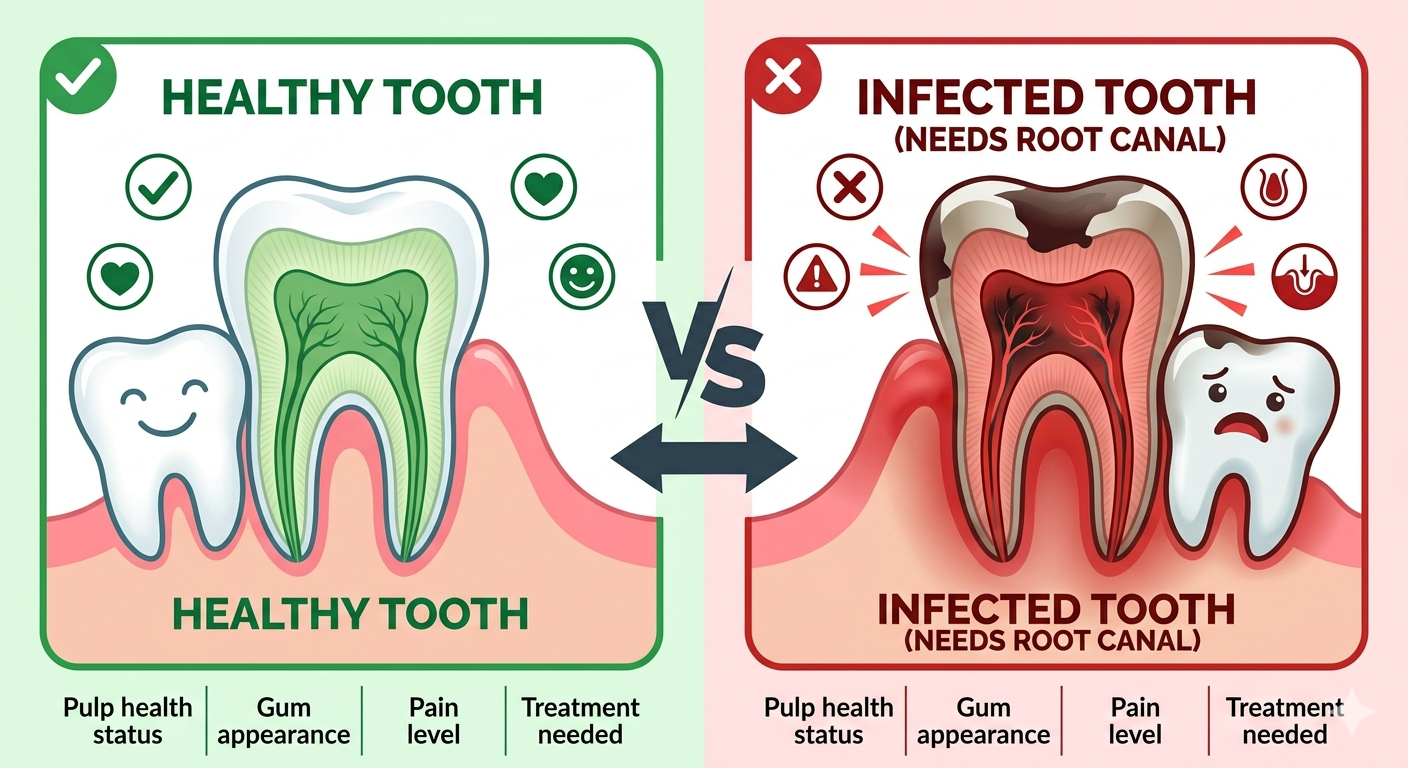
When bacteria enter your tooth (through a cavity, crack, or chip), they infect this pulp. If left untreated, the infection spreads, causing severe pain and potentially destroying the tooth. A root canal removes this infected pulp, cleans out the bacteria, and fills the empty space with a special material to prevent reinfection.
Think of it like this: if your tooth were a building, the pulp is like the internal wiring. When the wiring gets damaged, you don’t tear down the whole building. you fix the wiring and keep the building standing. That’s exactly what a root canal does.
How Do You Know You Need a Root Canal?
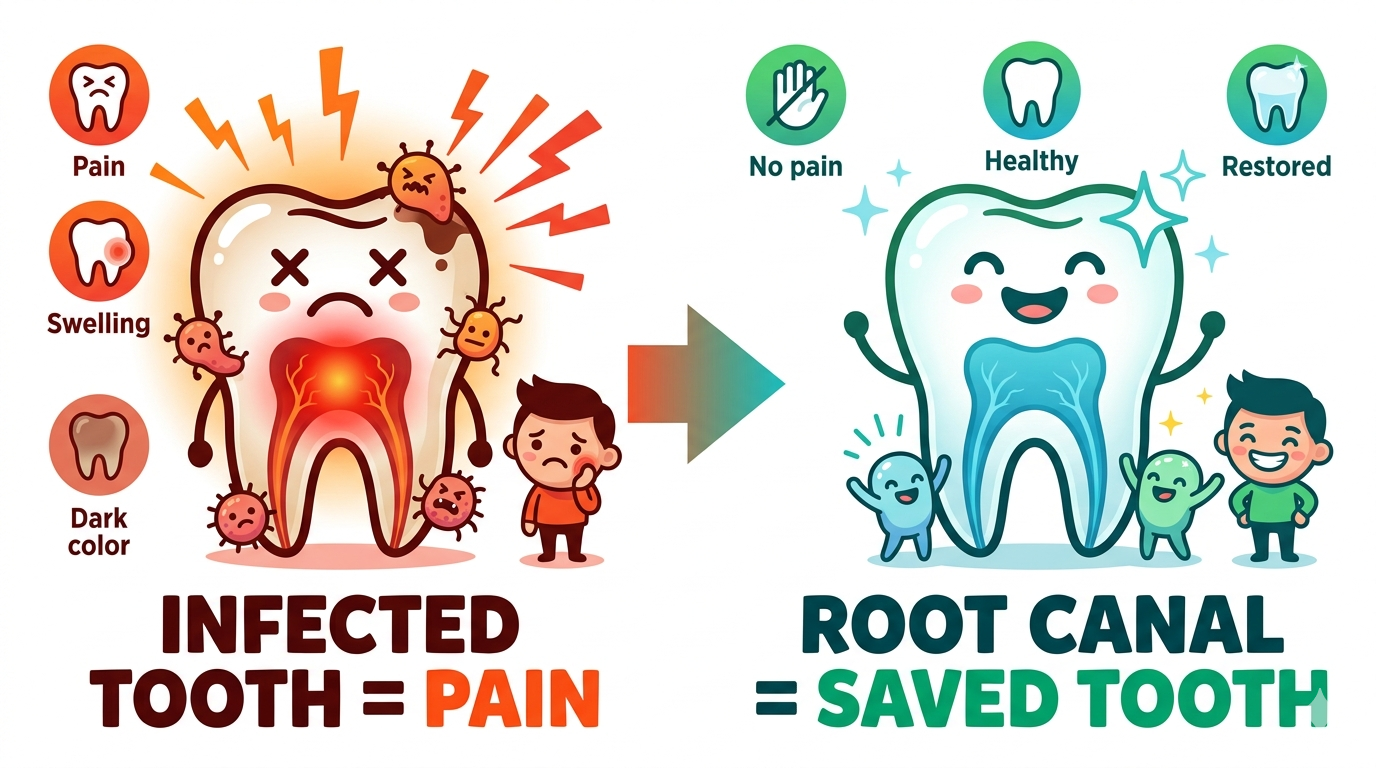
Your tooth might need a root canal if you notice any of these symptoms:
Severe Pain While Chewing or Biting
Throbbing pain that shoots through your jaw when you bite down or chew is often the first sign of pulp damage. You might feel it only on that specific tooth, and it can be intense enough to wake you up at night.
Sensitivity to Hot and Cold
A sharp, lingering sensitivity that stays even after you remove the hot or cold stimulus is different from normal tooth sensitivity. This usually means the pulp is inflamed.
Discoloration or Darkening
If your tooth suddenly looks grayish or darker than your other teeth, it can indicate that the pulp is dying. This happens because the blood supply to the tooth is cut off.
Swelling and Tenderness in Your Gums
You might notice a small pimple-like bump on your gums near the painful tooth, or your gums might be puffy and sore. Sometimes pus oozes from this bump, which is a sign of serious infection.
Loose Tooth
If the infection spreads to the bone supporting your tooth, it can weaken, making your tooth feel loose even though you haven’t hit it.
Facial Swelling or Jaw Pain
In serious cases, the infection spreads beyond the tooth root into your jawbone and facial tissues, causing swelling in your face or neck.
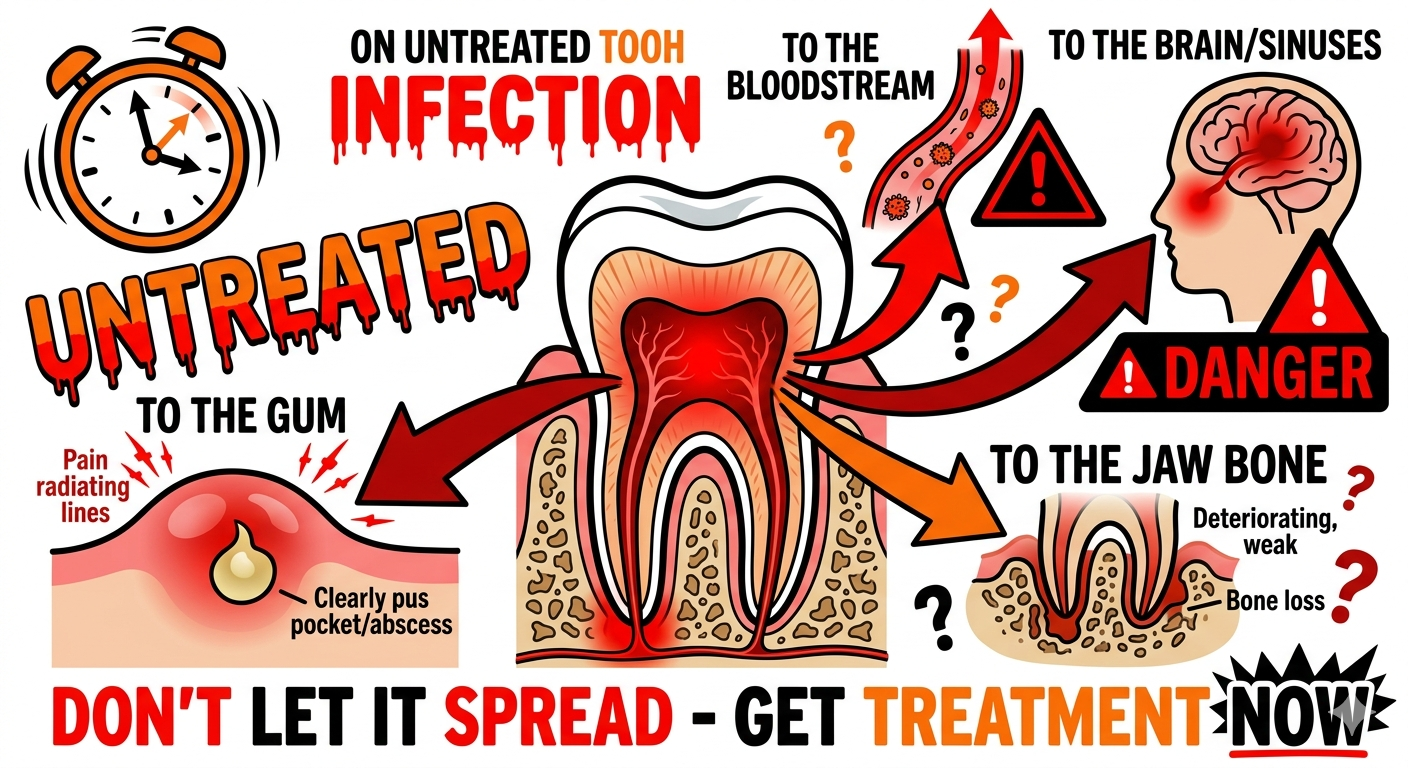
Important: Don’t wait if you have these symptoms. Untreated infections can spread to your sinuses, brain, or bloodstream-which is dangerous. Call your dentist immediately.
The Root Canal Procedure: What to Expect Step-by-Step
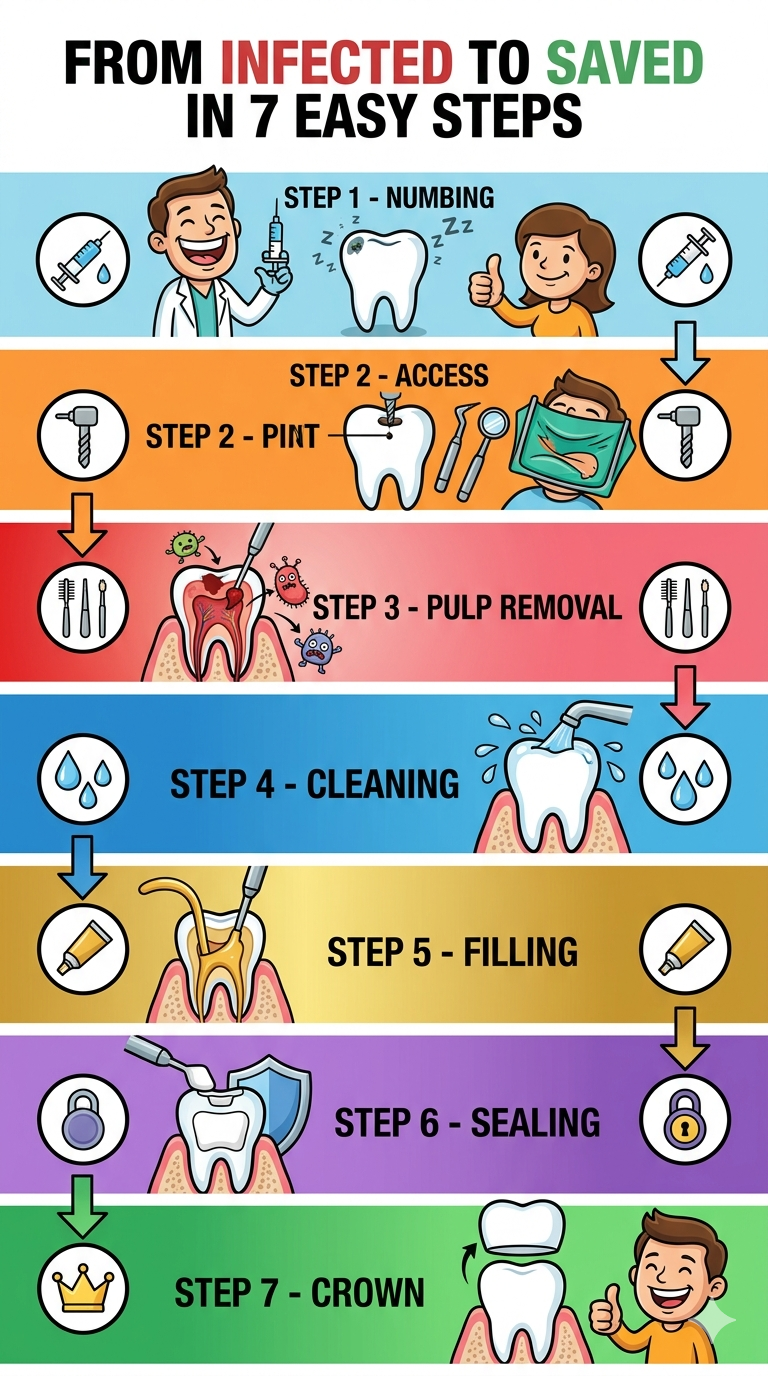
Understanding what happens during your root canal helps ease anxiety. Here’s the exact process:
Step 1 – Diagnosis and X-rays (Before Your Appointment)
Your dentist takes X-rays to see inside your tooth and confirm the pulp is infected. They might also do a sensitivity test (hot/cold) or tap your tooth to see how you react. This helps them decide if a root canal is truly needed or if another treatment might work.
Step 2 – Numbing (At the Beginning)
Your dentist applies topical numbing gel to your gum, then injects local anesthetic around the tooth. Within a few minutes, the entire area is completely numb you’ll feel pressure and vibration, but zero pain. If you’re very anxious, they might offer sedation to help you relax.
Step 3 – Creating Access (Opening the Tooth)
The dentist drills a small access hole through the crown of your tooth to reach the pulp chamber inside. A rubber dam (a thin rubber sheet) is placed around your tooth to keep it dry and protect your mouth during treatment.
Step 4 – Removing the Infected Pulp
Using tiny instruments called files, your dentist carefully removes the infected pulp from inside the tooth. They work from the crown down through the root canals, removing all damaged tissue. The canals are shaped and enlarged to make them easier to clean and fill.
Step 5 – Cleaning and Disinfecting
The empty canals are flushed with disinfectant solution to eliminate all bacteria and debris. This step is crucial for preventing reinfection.
Step 6 – Filling the Canals
Once the canals are completely clean and dry, they’re filled with a biocompatible material called gutta-percha (a rubber-like substance). A sealer paste helps the gutta-percha stick to the canal walls, creating a tight seal.
Step 7 – Sealing the Tooth
A temporary or permanent filling is placed in the access hole to seal the tooth and prevent food and bacteria from entering. Most root canals need a crown afterward for protection.
Timeline: Most root canals take 60-90 minutes. Complex cases might need 2 visits.
Is Root Canal Treatment Painful?
This is the #1 fear people have and it’s based on old myths. Here’s the truth:
During the Procedure: Minimal to No Pain
Thanks to modern anesthesia, you won’t feel pain during a root canal. You’ll feel pressure, vibration, and hear the sound of the drill, but actual pain? No. If you do feel pain, tell your dentist immediately they’ll give you more anesthetic.
Many patients say a root canal is actually less uncomfortable than getting a filling because the infected nerve is already causing pain removing it actually feels like relief.
After the Procedure: Mild Soreness is Normal
For a few days afterward, your tooth might feel tender or sore, especially when chewing. This is completely normal and manageable with over-the-counter pain medication like ibuprofen or acetaminophen.
Most patients return to work or school the same day. You’ll be numb for 2-4 hours after, so avoid eating until the numbness wears off.
When to Call Your Dentist
If pain lasts more than a few days, or if you have severe throbbing pain, contact your dentist. This could indicate:
- Incomplete pulp removal
- Reinfection
- Another issue needing attention
Root Canal vs. Extraction: Why Save Your Tooth?
The Alternative: Removing the tooth and replacing it with an implant or bridge
Why keeping your natural tooth is better:
Natural Tooth Function
Your natural tooth works perfectly with your bite and jaw. Implants and bridges are good replacements, but nothing works exactly like your real tooth.
Preserves Bone
When you lose a tooth, the bone underneath starts to shrink (bone resorption). This happens because the bone no longer has a tooth root stimulating it. Over time, this changes your facial structure and makes you look older.
Cost Comparison
A root canal + crown typically costs decided after the inspection and depending on which tooth. An implant and involves more procedures over months. Root canal is usually the more affordable option.
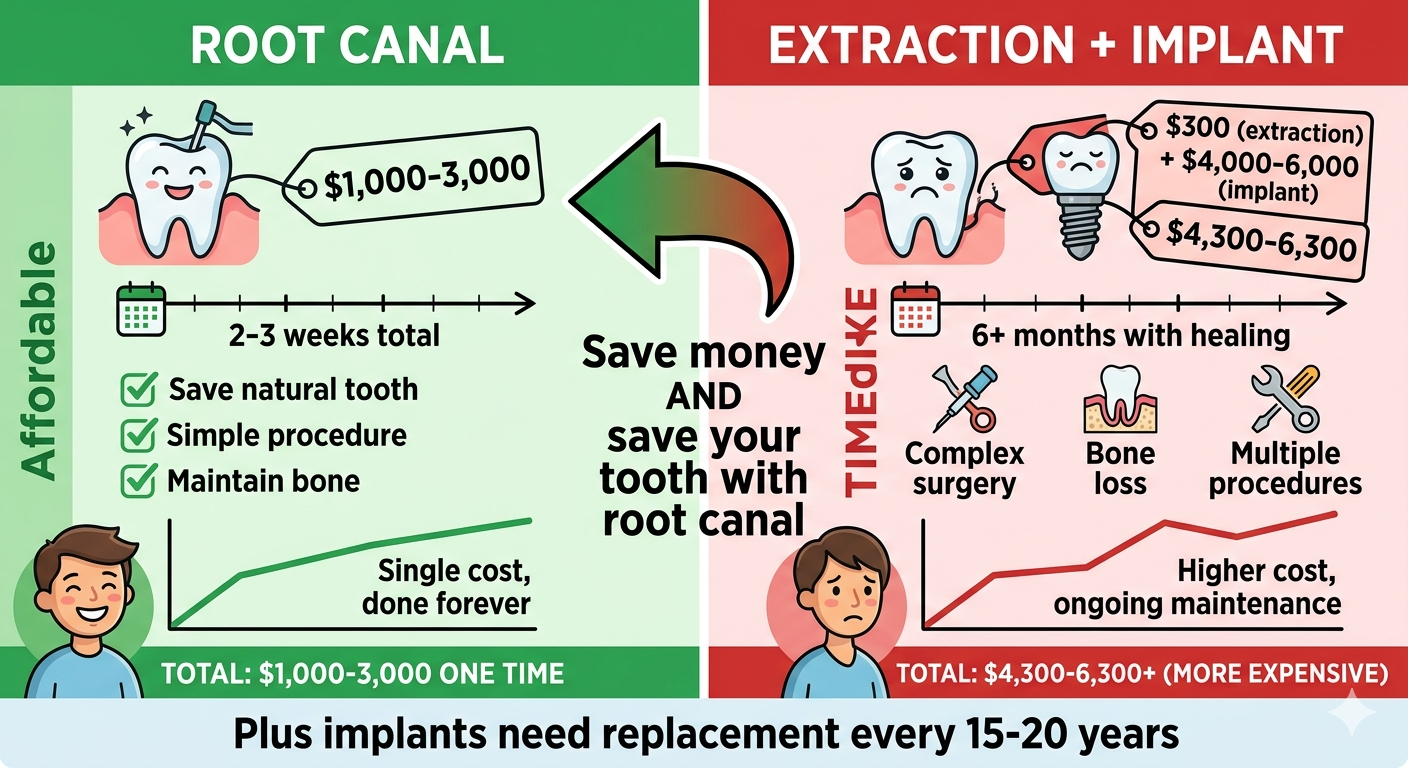
Simplicity
Root canal = 1-2 appointments and you’re done. Implants require surgery, healing time (3-6 months), and multiple appointments.
Success Rate
Root canals have a 90-95% success rate. Implants have about 95-98% success, but they’re more complex and require more aftercare.
How Long Does Recovery Take?
Most people recover in less than one week:
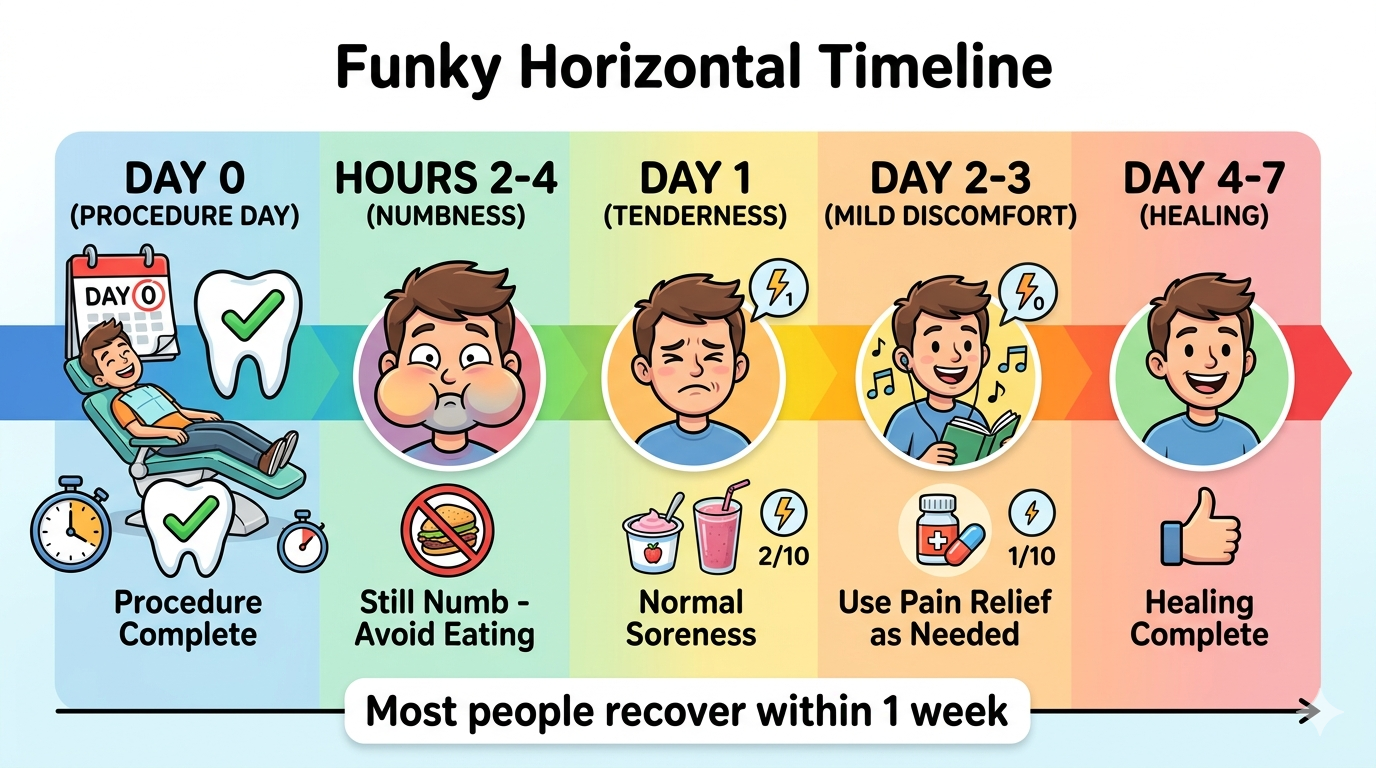
First Few Days
You’ll be sore and might have mild discomfort, but this is normal. Use over-the-counter pain medication as needed. Eat soft foods like mashed potatoes, yogurt, smoothies, and soup.
First Week
Sensitivity to temperature should fade. Avoid chewing on the treated tooth until your permanent crown is placed.
After Crown Placement (2-3 weeks later)
Your tooth is fully restored and functions normally. You can eat and chew anything without restriction.
Long-term
With proper care, a tooth that’s had a root canal can last your entire lifetime. The key is getting a crown to protect it and maintaining good oral hygiene.
Root Canal Success Rates and Long-term Outcomes
Root canal treatment is one of the most successful dental procedures:
Initial Success Rate: 90-95%
This means 9 out of 10 root canals successfully save the tooth and eliminate the infection on the first try.
Why Some Fail (5-10% of cases)
- Curved or blocked canals that are difficult to clean
- Deep cracks that extend below the gum line
- Undetected additional canals
- Reinfection from poor seal
Retreatment: Success Rate 80-90%
If a root canal fails, it can often be retreated (redone) with a good chance of success the second time.
Tooth Longevity
With a crown and proper care, most teeth that have had root canals last:
- 10+ years: Very common
- 20+ years: Common with good care
- Lifetime: Possible with excellent oral hygiene
Root Canal Myths Debunked
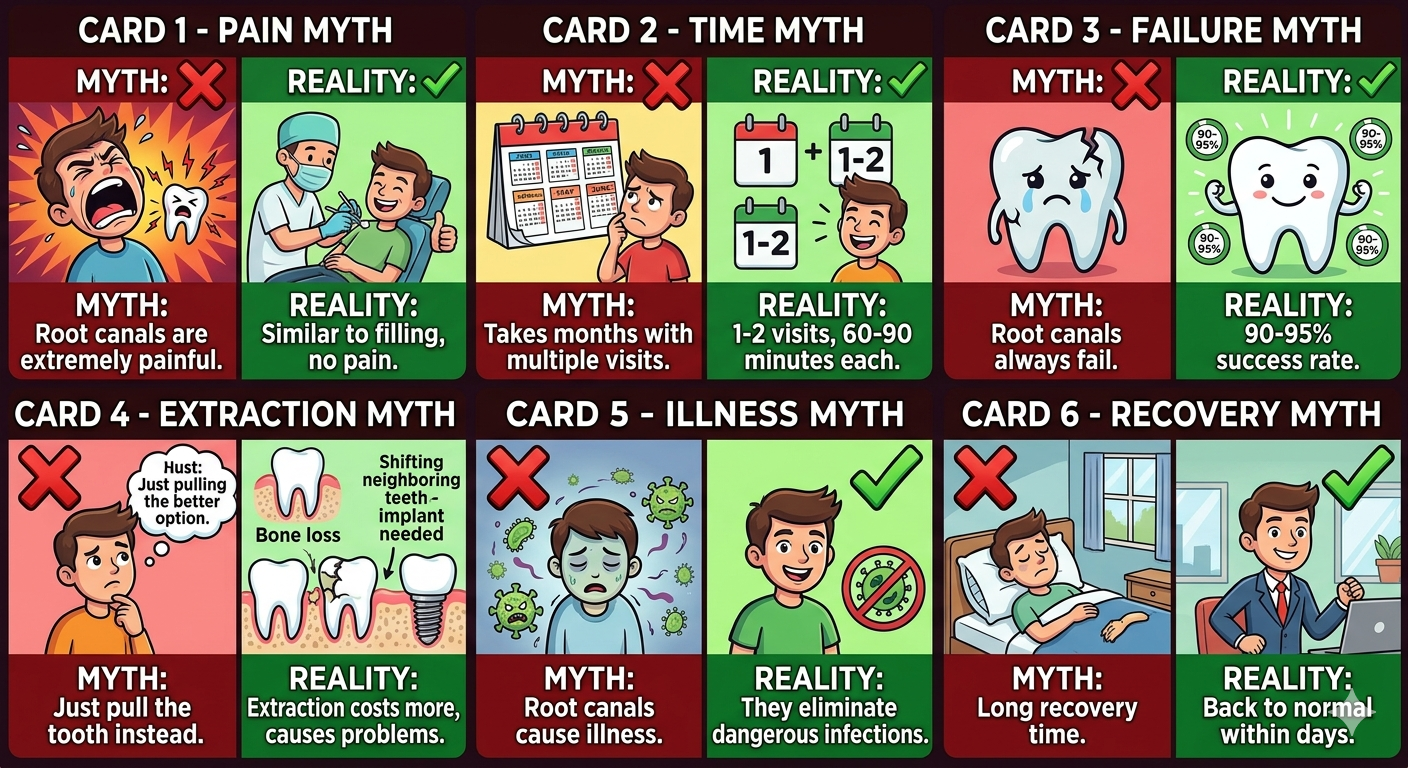
Myth #1: “Root canals are extremely painful” Truth: They’re no more painful than a filling. The infection itself causes pain-removing it brings relief.
Myth #2: “You need multiple appointments spread over months” Truth: Most root canals are completed in 1-2 visits, with each visit taking 60-90 minutes.
Myth #3: “Root canals always fail” Truth: 90-95% success rate is actually very high. Failures are usually retreatable.
Myth #4: “You can just pull the tooth instead” Truth: Extraction costs more long-term and leads to bone loss and shifting teeth.
Myth #5: “Root canals cause illness or spread infection” Truth: The opposite is true-root canals eliminate infections that could spread and cause serious illness.
FAQ – Root Canal Treatment
How long does a root canal take?
Most root canals take 60-90 minutes. The time depends on how many canals your tooth has (front teeth usually have 1, molars have 3-4) and how complicated the infection is.
Can I eat after my root canal?
Avoid eating until the numbness completely wears off (2-4 hours). You might bite your cheek or tongue without realizing it. Once numb wears off, stick to soft foods for a few days—your tooth will be tender.
Will I need a crown after my root canal?
Most likely yes. After removing the pulp, your tooth becomes fragile and needs a crown to protect it and restore full function. Your dentist will discuss this with you.
Can a root canal get infected again?
Yes, but rarely (5-10% of cases). This happens if bacteria enter through a crack in the crown, or if the seal isn’t perfect. This is why a good crown is essential.
Do I need antibiotics before or after root canal?
Your dentist might prescribe antibiotics if the infection spread beyond the tooth. This is decided on a case-by-case basis during your exam.
What’s the difference between a root canal and a root canal specialist (endodontist)?
A general dentist can do most root canals. An endodontist is a specialist with extra training in complex cases. If your tooth is difficult to treat, you might be referred to an endodontist.
Can root canals be done on baby teeth?
Yes, baby teeth can have root canals if the pulp is infected. This is done to keep the baby tooth until it naturally falls out, maintaining space for the permanent tooth.
How do I prevent needing a root canal?
- Brush twice daily with fluoride toothpaste
- Floss every day
- Avoid chewing hard objects (ice, hard candy, bones)
- Wear a mouthguard during sports
- Get regular dental checkups (every 6 months)
- Address cavities immediately before they become deep
Can a root canal be done on a tooth with a large filling already?
Yes, but it’s more complex. Your dentist removes the old filling to access the pulp, then does the root canal, then places a new filling or crown.
What happens if I don’t get a root canal when I need one?
The infection spreads, causing:
- Severe, unbearable pain
- Abscess (collection of pus)
- Bone loss around the tooth root
- Facial swelling
- Eventually tooth loss
- Possible spread to sinuses or bloodstream (dangerous)
Getting treatment early prevents all of this.
When to See a Dentist for Root Canal Symptoms
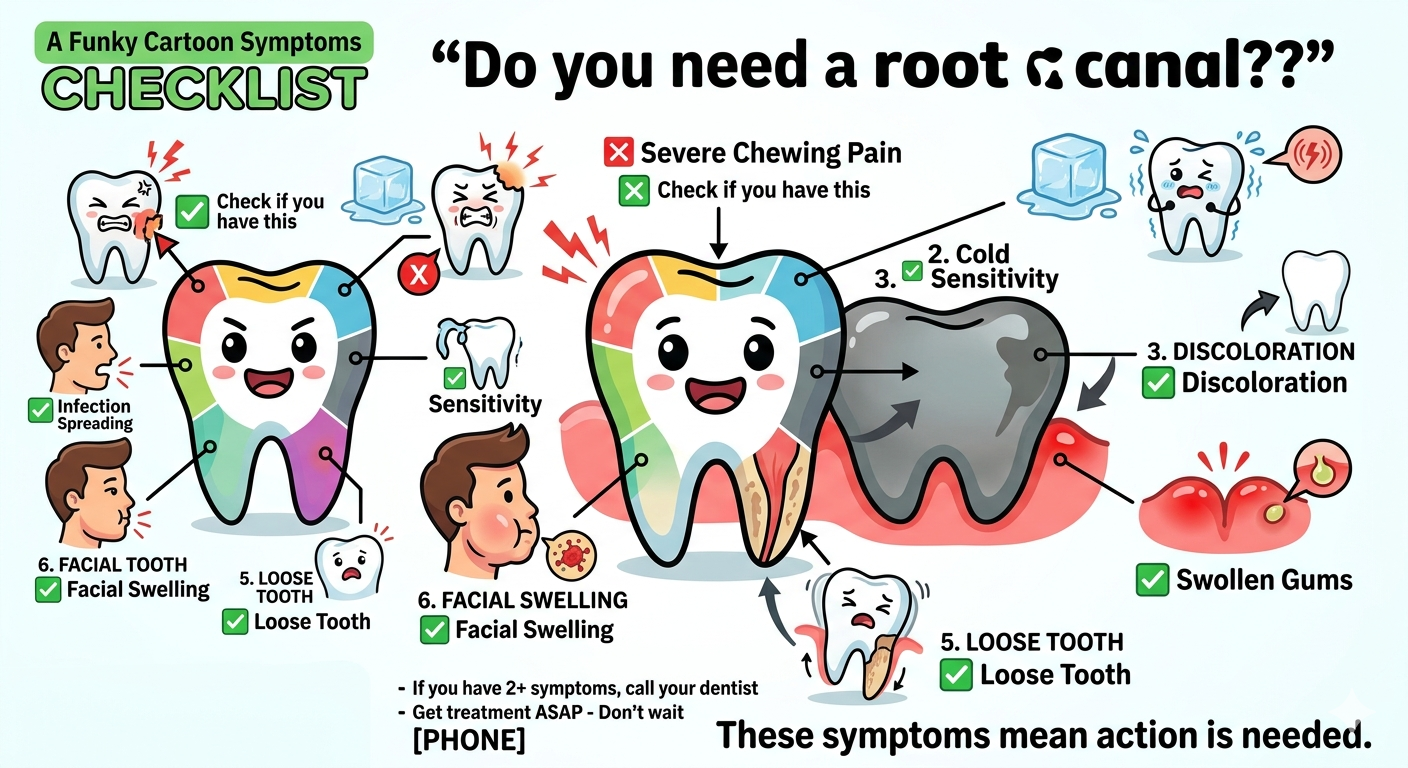
Don’t wait if you have:
- Severe, throbbing tooth pain
- Pain that wakes you up at night
- Swelling in your gums with pus
- Facial swelling or jaw tenderness
- Tooth that’s discolored or loose
Early treatment is always better than emergency treatment. Many serious complications can be prevented with prompt care.
Root Canal at Talpadent: Your Complete Experience
At Talpadent in Luxembourg, we’ve performed hundreds of successful root canals.
Free Initial Consultation
We examine your tooth, take X-rays, and explain exactly what’s happening. We’ll discuss whether a root canal is truly needed and answer all your questions with no pressure.
Compassionate Care
We understand root canals make people nervous. Our team takes time to explain every step, uses modern anesthesia, and keeps you comfortable throughout.
Expert Treatment
Our dentists are trained in root canal treatment. For complex cases, we work with endodontic specialists to ensure the best outcome.
Complete Restoration
We don’t just do the root canal we also handle the crown that protects your tooth long-term. Your tooth is completely restored and functions like new.
Aftercare Support
We provide detailed aftercare instructions and monitor your tooth’s healing. We’re here if you have any questions or concerns.
The Bottom Line: Save Your Natural Tooth
A root canal isn’t something to fear-it’s a procedure that saves your smile. Modern root canals are successful, comfortable, and far superior to extraction. If you’re experiencing tooth pain or think you might need a root canal, don’t wait.
Contact Talpadent today for a free consultation. We’ll examine your tooth, explain your options, and create a treatment plan that saves your natural smile.
Your tooth is worth saving. Your smile is worth protecting.