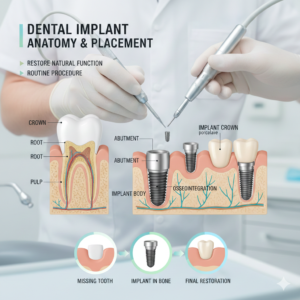


Dental implants are artificial tooth roots surgically placed into your jawbone to support replacement teeth. When you’re missing one or more teeth, dental implants provide a permanent solution that functions like natural teeth, preserves your jawbone, and maintains your facial appearance. Implant surgery is one of the most successful oral surgery procedures available today.
In simple terms: Your oral surgeon places a titanium implant into your jawbone where it fuses with bone, then a crown is attached to create a tooth that looks and functions like a natural tooth.
Essential Facts About Dental Implants
What it is: Surgical placement of an artificial tooth root (implant) that supports a replacement tooth or bridge
Why you might need it: Single tooth missing, multiple missing teeth, or all teeth missing; better alternative to dentures or bridges
Implant advantages: Preserve jawbone, function like natural teeth, look identical to natural teeth, last 20+ years
Procedure time: 60-90 minutes for single implant; longer for multiple implants
Osseointegration: 3-6 months for bone to fuse with implant (varies by patient)
Restoration: Crown placed after bone healing and implant integration
Success rate: 95%+ success rate with proper placement and care
Why Choose Dental Implants?
Understanding the benefits of dental implants helps you make an informed decision about tooth replacement. Implants offer significant advantages over other tooth replacement options.
Preserve Your Jawbone
When you lose a tooth, the root no longer stimulates your jawbone. Without this stimulation, your jawbone begins deteriorating immediately. Bone loss accelerates over the first year after tooth loss, then continues slowly throughout your life.
Bone loss consequences:
- Facial appearance changes (looks older)
- Remaining teeth shift out of alignment
- Bite relationships alter
- Further tooth loss becomes more likely
Dental implants function like natural tooth roots by stimulating your jawbone, preventing bone loss. This preserves your facial structure and protects your remaining teeth.
Dentures and bridges don’t prevent bone loss because they rest on your gums, not in your bone. Over time, denture wearers experience significant facial collapse and must frequently get new dentures as the bone shrinks. Implants solve this problem.
Function Like Natural Teeth
Dental implants restore full chewing function. Natural teeth have a bite force of 200 pounds; dentures only provide 25 pounds. This limitation with dentures restricts your diet.
With dental implants, you can:
- Eat all foods (hard, crunchy, chewy)
- Chew normally on both sides of mouth
- Experience natural proprioception (tooth sensation)
- Maintain full nutritional intake
- Eat with confidence
Look Identical to Natural Teeth
Implant crowns are custom-made to match your natural teeth exactly in color, shape, and size. Unlike dentures that look obviously artificial, no one will know you have an implant. The crown sits on the implant like a real tooth would sit on a root.
Aesthetic benefits:
- Smile looks completely natural
- No visible titanium or metal
- Seamless integration with your smile
- Confidence boost
- Professional appearance
Last Decades
With proper care, dental implants last 20, 30, or even 40+ years. The implant itself is made of titanium, which doesn’t decay and rarely fails. The crown restoration typically lasts 10-15 years before replacement becomes cosmetically advisable.
Compare this to dentures (need replacement every 5-7 years), bridges (last 5-15 years, require reducing healthy teeth), or repeated tooth loss. Implants are the most durable solution.
Are You a Candidate for Dental Implants?
While most people can have dental implants, certain requirements must be met for successful placement and long-term implant survival.
Bone Volume Requirements
Your jawbone must have adequate volume to support the implant. Implants are typically 4-5mm in diameter and 10-16mm long. The implant must be surrounded by bone on all sides for stability and osseointegration.
If you don’t have enough bone:
- Bone grafting can build volume (takes 4-6 months)
- Sinus lift may be needed for upper back teeth
- Zygomatic implants use cheekbone for very severe bone loss
Most patients with bone loss can still have implants with bone grafting. It requires patience but works well.
Gum Health Requirements
Your gums must be healthy before implant placement. Gum disease (periodontitis) prevents successful osseointegration and leads to implant failure. If you have gum disease, it must be treated before implant surgery.
Gum health assessment:
- No active gum disease
- No infection around teeth
- Adequate gum thickness and height
- Good oral hygiene demonstrated
Overall Health Considerations
Certain medical conditions affect implant success. Your surgeon will review your complete medical history.
Conditions requiring special consideration:
- Uncontrolled diabetes (increases infection risk; controlled diabetes is acceptable)
- Autoimmune diseases
- Bone diseases (osteoporosis, Paget’s disease)
- Current cancer treatment
- Medications affecting bone healing
Most people with medical conditions can still have implants. Your oral surgeon will determine if modification is needed.
Age Considerations
You must be at least 16-18 years old when the jawbone has finished growing. There’s no upper age limit. Elderly patients with healthy bones and good health can successfully have implants.
Smoking Impact
Smoking significantly reduces implant success rates. Smoking decreases blood flow to healing tissues and impairs bone healing. Smokers have higher implant failure rates.
Smoking recommendations:
- Ideally quit before implant surgery
- At minimum, don’t smoke for 72 hours after surgery
- Avoid smoking throughout healing (3-6 months ideal)
- Quitting improves long-term implant success dramatically
The Dental Implant Process: Step-by-Step
The journey from missing tooth to fully restored implant takes 3-6 months and involves several phases. Understanding the complete process helps you prepare and manage expectations.
Phase 1: Consultation and Evaluation (Weeks 1-2)
Your oral surgeon examines your mouth, reviews your medical history, and takes detailed imaging (X-rays, CT scans, 3D imaging).
During evaluation:
- Assessment of bone volume and quality
- Gum health evaluation
- Number and location of missing teeth
- Overall jaw anatomy reviewed
- Implant placement plan created
- Treatment timeline discussed
- Cost estimate provided
Imaging shows:
- Bone thickness and height in implant area
- Location of nerves and sinuses
- Bone density
- Exact positioning for implant placement

Phase 2: Bone Grafting (If Needed) – Weeks 3-16
If you don’t have adequate bone, grafting is performed first. The graft is allowed to integrate for 4-6 months before implant placement.
If you have sufficient bone, proceed directly to implant placement. This accelerates your timeline significantly.
Phase 3: Implant Placement Surgery – Week 16-20
Implant placement surgery is performed under local anesthesia, IV sedation, or general anesthesia depending on complexity and patient preference.
Surgical steps:
- Anesthesia administration
- Surgical site preparation and sterilization
- Precise bone drilling using surgical guides
- Implant body insertion into bone
- Protective cover placed on implant
- Gum closure with sutures
- Recovery room monitoring
Procedure time: 60-90 minutes for single implant; longer for multiple
Phase 4: Osseointegration (Weeks 20-36)
After implant placement, the implant must remain covered while bone fuses around it. This osseointegration process takes 3-6 months depending on bone quality and your healing rate.
During this phase:
- Implant remains under the gum
- Bone gradually fuses with implant surface
- You cannot chew on the implant area
- Healing progresses invisibly
- Regular follow-up appointments monitor healing
Phase 5: Abutment and Crown Placement (Weeks 36-40)
Once osseointegration is complete, your oral surgeon places an abutment (connector piece) on the implant. Your dentist then takes impressions and creates your crown.
Crown placement process:
- Abutment attached to implant
- Impressions taken for custom crown
- Temporary crown placed while permanent is made
- Permanent crown fabricated (1-2 weeks)
- Permanent crown cemented or screwed to abutment
- Bite and alignment checked
Recovery from Implant Surgery
Implant placement recovery is usually straightforward with minimal downtime. Most people return to work the next day, though some discomfort is normal.
Immediate Recovery (First 24 Hours)
Expect:
- Numbness from anesthesia (several hours)
- Mild to moderate swelling at surgical site
- Minimal bleeding or oozing
- Mild pain or discomfort
Pain management:
- Prescribed pain medication as directed
- Ice application (20 minutes on, 20 off) first 24 hours
- Head elevation while resting
- Over-the-counter pain relievers if tolerated
Important restrictions:
- Don’t disturb surgical site
- Don’t use straws (suction disrupts healing)
- Avoid hot, hard, crunchy foods
- Don’t smoke
- Limit strenuous activity
Days 2-7: Early Healing
Expect:
- Swelling peaks at 48-72 hours
- Pain decreasing each day
- Bruising may appear
- Sutures remain in place
- Gradual improvement in opening mouth
Care:
- Continue ice first 48-72 hours
- Switch to warm compresses after 72 hours
- Gentle oral hygiene (avoid implant area)
- Soft foods only
- Stay well hydrated
- Rest adequately
Weeks 2-4: Progressive Healing
Expect:
- Swelling mostly resolved
- Bruising faded
- Pain minimal
- Sutures removed around day 7-10
- Can gradually return to normal diet
Implant Success Rates and Longevity
Dental implants have outstanding success rates when properly placed and maintained.

Success Statistics
Overall success rate: 95-98% for implants placed in adequate bone 10-year survival: 90%+ of implants remain functional 20-year survival: 80-85% of implants remain functional Primary cause of failure: Implant failure is usually within first year (rare)
Why Some Implants Fail
Implant failure is uncommon but possible:
Early failure (first 6 months):
- Poor bone quality
- Infection after surgery
- Smoking interfering with healing
- Insufficient osseointegration
- Implant placed in inadequate bone
Late failure (after integration):
- Severe gum disease around implant
- Smoking
- Poor oral hygiene
- Excessive force on implant
- Trauma to implant area
- Implant fracture (rare)
How to Ensure Success
Maximize implant longevity:
- Maintain excellent oral hygiene
- Don’t smoke (smoking is primary risk factor)
- Regular professional cleanings
- Professional monitoring of implant
- Avoid chewing on hard objects
- Manage medical conditions (especially diabetes)
- Follow surgeon’s instructions
- Address problems immediately
FAQ: Common Questions About Dental Implants
Q: How long do dental implants last?
A: With proper care, implants last 20-40+ years. The titanium implant itself rarely fails. The crown restoration typically needs replacement after 10-15 years for cosmetic reasons, though it may last longer.
Q: Is implant surgery painful?
A: Implant placement surgery is not painful because of anesthesia. You may feel pressure and vibration but not pain. Pain after surgery is normal and well-controlled with medication.
Q: Can I get an implant if I have bone loss?
A: Yes. Bone grafting can restore adequate bone volume. This requires 4-6 months of healing before implant placement, but most patients with bone loss can eventually have implants.
Q: What if my implant fails?
A: Implant failure is rare (less than 5%). If it does fail, the implant is removed and bone grafting is performed. After healing, another implant can be placed. Success rates for replacement implants are high.
Q: What maintenance do implants require?
A: Implants require the same care as natural teeth: brush twice daily, floss daily, and visit your dentist every 6 months. Unlike natural teeth, implants cannot decay, but the bone and gums around them can develop disease if neglected.
Q: Are implants better than bridges or dentures?
A: Yes, in most ways. Implants preserve bone, function like natural teeth, look identical to natural teeth, and last decades. Bridges require reducing healthy adjacent teeth. Dentures cause bone loss and need frequent replacement. Implants are the superior long-term solution.
Implants as Part of Your Comprehensive Oral Health
Dental implants restore your mouth to full function, but they’re best positioned within comprehensive oral health care.
Before implants:
- Address any gum disease
- Complete any necessary dental work
- Establish excellent oral hygiene habits
- Optimize medical conditions (especially diabetes)
After implants:
- Maintain meticulous oral hygiene
- Regular professional monitoring
- Protect from trauma
- Address any complications immediately
Long-term success depends on:
- Quality surgical placement
- Your commitment to excellent oral hygiene
- Regular professional care
- Management of medical conditions
- Immediate treatment of problems
Final Thoughts
Dental implants represent the most advanced and successful solution for replacing missing teeth. They preserve your jawbone, function like natural teeth, and last decades with proper care. The initial investment of 3-6 months for the implant process yields decades of superior function and appearance.
If you’re missing teeth and considering your options, dental implants offer the best long-term outcome. Consulting with an experienced oral surgeon helps you understand whether implants are right for your specific situation. With modern surgical techniques and high success rates, implants give you back the natural tooth function and confidence you lost.
If you don’t have adequate bone, grafting is performed first. The bone graft process takes 4-6 months to integrate before implant placement. For detailed information about bone grafting, including types of grafts, success rates, and the timeline for integration, see our comprehensive guide to oral surgery procedures.