The honest answer: There is no permanent instant fix for tooth nerve pain but you can significantly reduce it within minutes using a combination of targeted home remedies. The fastest acting options are topical benzocaine gel or clove oil applied directly to the tooth (numbing effect in 2–5 minutes), combined with ibuprofen taken orally to reduce underlying inflammation. A cold compress on the cheek and a warm salt water rinse support these. Crucially, these measures mask the pain they do not treat its cause. Tooth nerve pain always has a structural or infectious cause a cavity, crack, exposed root, or abscess that will worsen without professional treatment.
Tooth nerve pain is one of the sharpest, most disruptive pains the human body produces. It does not wait for a convenient moment it arrives mid-meal, at 2am, or right before an important day. Before you can get to a dentist, you need relief now. This guide gives you the fastest, most effective home remedies available ranked by speed, explained properly, and paired with honest guidance on when home treatment needs to become professional dental treatment.
First Why Is Your Tooth Nerve Hurting?
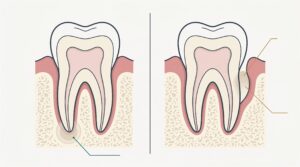
Understanding the cause of tooth nerve pain matters for two reasons: it tells you which remedy will work best, and it tells you how urgently you need professional care. The nerve of your tooth housed in the central pulp is normally completely insulated by layers of enamel and dentin. It is designed never to be touched by temperature, pressure, or bacteria from the outside world.
When it hurts, something has broken through that insulation. The most common causes are a cavity that has reached the pulp, a cracked tooth exposing the nerve, gum recession uncovering the root, a dental abscess building pressure around the root, or a lost filling leaving the inner tooth exposed. Good prevention and early diagnosis are what stops nerve pain from developing in the first place but once it has started, the priority shifts to managing it while you arrange care. Understanding dental pulp anatomy and nerve pathways helps clarify why these remedies work the way they do.
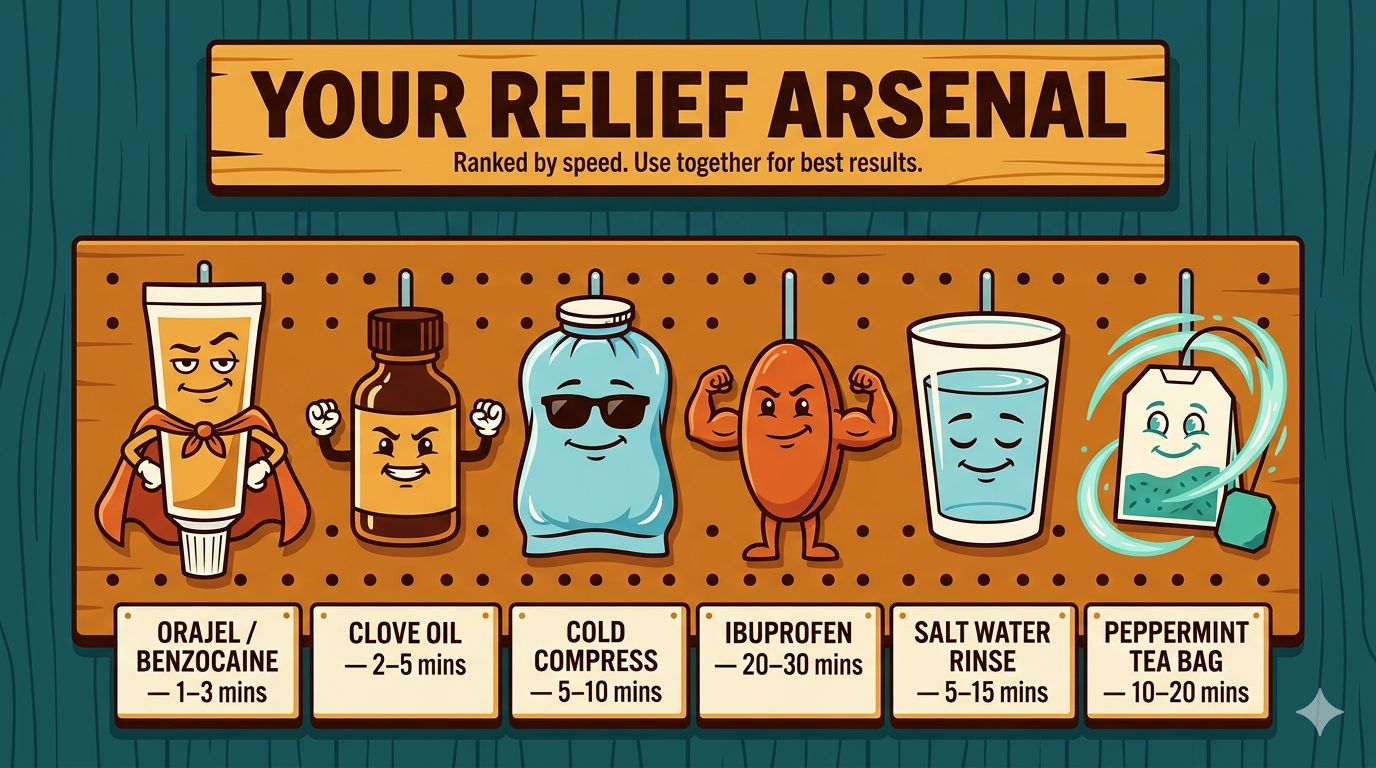
6 Ways to Stop Tooth Nerve Pain Fast Ranked by Speed
These remedies are ordered from fastest-acting to longest-lasting. For severe pain, combining remedies 1, 2, and 3 simultaneously gives the strongest short-term result.
1
Topical Benzocaine Gel (Orajel or equivalent)
⚡ Works in: 1–3 minutes
Apply a small amount of over-the-counter benzocaine gel directly onto the painful tooth and surrounding gum using a cotton swab. Benzocaine is a local anaesthetic that temporarily blocks nerve signal transmission at the surface. It is the fastest-acting option available without a prescription. The effect typically lasts 20–30 minutes and can be reapplied every few hours. Apply to a dry surface for best results pat the area dry with a clean tissue before application.
⚠ Do not use in children under 2 years old. Use sparingly excessive use can cause a rare condition called methemoglobinemia. Follow package directions strictly.
2
Clove Oil (Eugenol) Applied Directly
⚡ Works in: 2–5 minutes
Clove oil contains
eugenol as a dental analgesic a compound dentists have used professionally for decades precisely because of its anaesthetic and antibacterial properties. Mix 2–3 drops of pure clove oil with a teaspoon of carrier oil such as olive or coconut oil to dilute it. Apply the mixture directly to the painful tooth using a cotton ball or swab and hold it in place for 30–60 seconds. The numbing effect builds within a few minutes and can last significantly longer than benzocaine gel. Do not swallow the mixture and rinse gently after removing the cotton.
⚠ Use only diluted clove oil undiluted application can burn gum tissue. Avoid in pregnancy without medical guidance. Do not use if the pain may indicate a need for
root canal therapy clove oil delays but does not replace treatment.
3
Cold Compress on the Cheek
⚡ Works in: 5–10 minutes
Wrap an ice pack or a bag of frozen vegetables in a thin cloth and hold it against your cheek on the affected side for 15–20 minutes at a time. Cold causes vasoconstriction the blood vessels narrow, which reduces blood flow to the inflamed area and numbs the nerve endings. This is particularly effective when the pain has a throbbing quality, which usually indicates inflammation or infection-related pressure around the root. Remove for 20 minutes between applications to avoid skin damage from prolonged cold exposure.
⚠ Never apply ice directly to the tooth surface if cold is already a trigger this will worsen pain. Apply only to the outside of the cheek.
4
Ibuprofen Anti-Inflammatory Pain Relief
⚡ Works in: 20–30 minutes
Ibuprofen is the single most effective over-the-counter option for dental nerve pain because it addresses inflammation which is usually the driver of the throbbing quality. Follow the
ibuprofen and acetaminophen dosage guidelines for your age, weight, and any existing medical conditions. For severe pain, taking ibuprofen and acetaminophen together at their standard doses and on an alternating schedule is more effective than either alone, as they work through different mechanisms. Take with food to protect the stomach. This approach is especially useful when the pain has an inflammatory origin such as pulpitis or a cracked tooth that may need
dental crowns to protect it.
⚠ Do not take ibuprofen if you have kidney disease, peptic ulcers, or are on blood thinners without medical advice. Do not exceed recommended dosage.
5
Warm Saltwater Rinse
⚡ Works in: 5–15 minutes
Dissolve half a teaspoon of table salt in a glass of warm (not hot) water. Swish gently around the painful tooth for 30 seconds then spit do not swallow. Repeat 2–3 times. Saltwater creates a hypertonic environment that draws fluid out of swollen gum tissue, reducing the pressure around the tooth root that contributes to throbbing pain. It also reduces bacterial load around the affected area. While slower than topical anaesthetics, a saltwater rinse has a longer-lasting soothing effect and can be repeated every hour if needed.
6
Peppermint Tea Bag (Slightly Warm or Cooled)
⚡ Works in: 10–20 minutes
A used peppermint tea bag either slightly warm or cooled in the fridge can be held directly against the painful tooth and gum for several minutes. Peppermint contains menthol, which produces a cooling, mildly anaesthetic sensation on nerve endings and has mild antibacterial properties. This is a gentler remedy best suited to mild-to-moderate pain or as an adjunct alongside stronger options. It is also one of the safest options for use during pregnancy, though any persistent pain during pregnancy should be evaluated promptly by a dentist.
💡
For maximum short-term relief: Combine remedy 1 (benzocaine gel applied topically) with remedy 3 (cold compress on the cheek) and remedy 4 (ibuprofen taken orally). All three work through different mechanisms simultaneously topical nerve block, vasoconstriction, and systemic anti-inflammation. This combination gives the strongest relief available without a prescription.
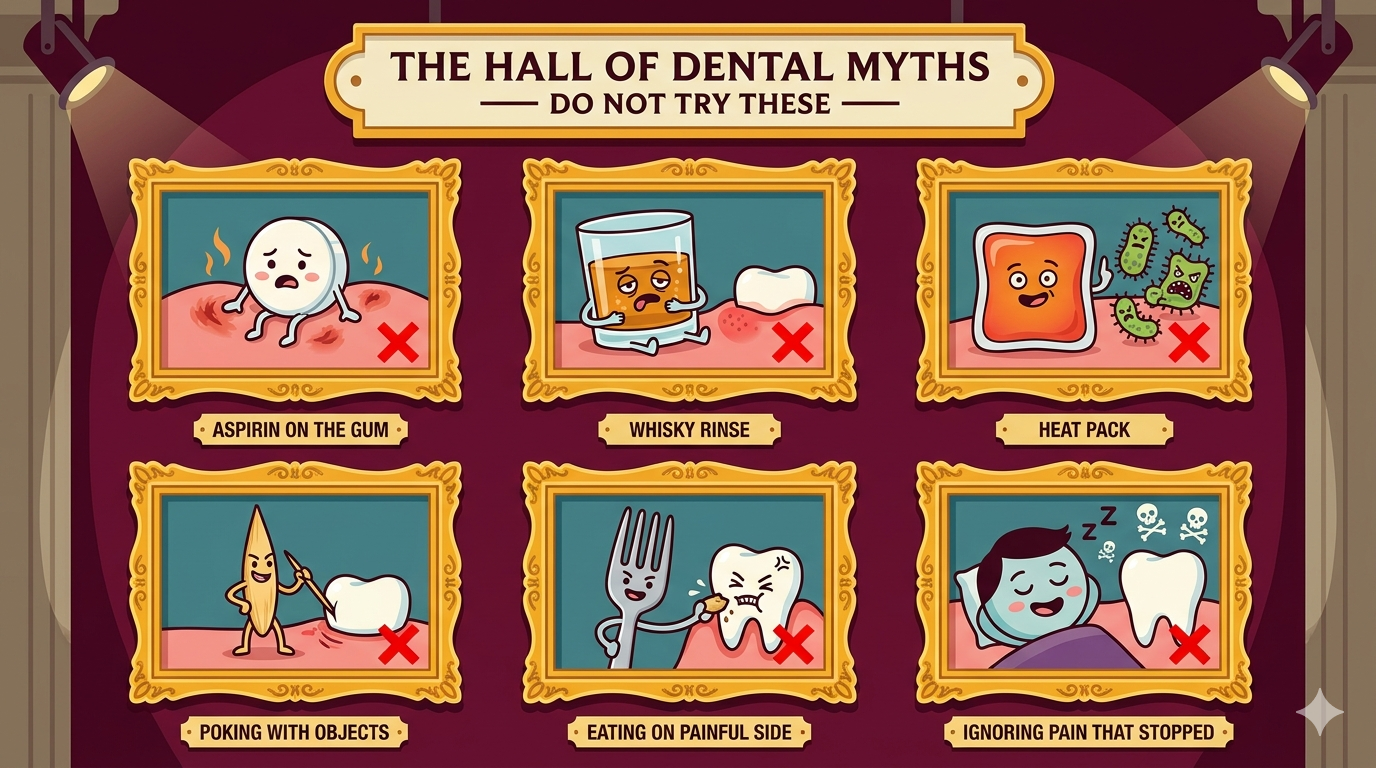
What Not to Do Common Mistakes That Make Nerve Pain Worse
Most articles on this topic focus entirely on what to do. Nobody covers what commonly makes tooth nerve pain significantly worse. Avoiding these mistakes is just as important as the remedies above.
✗ Applying Aspirin Directly to the Tooth
A common myth. Placing an aspirin tablet directly on the gum does not work aspirin is not absorbed through gum tissue in this way. It simply causes a chemical burn on the soft tissue, worsening your discomfort. Take aspirin orally if at all.
✗ Using Alcohol (Whisky) on the Tooth
Another widely repeated myth. Alcohol does not reach the nerve through intact tooth structure, and holding spirits in your mouth irritates already-inflamed gum tissue. It provides no meaningful numbing at the nerve level.
✗ Applying Heat to the Face
If the pain has an infectious component abscess or bacterial pulpitis applying heat accelerates bacterial activity and increases swelling. Heat feels soothing at first but worsens infection-driven pain within hours. Use cold, not heat.
✗ Probing the Tooth with Objects
Using toothpicks, pins, or fingers to probe the painful tooth introduces bacteria into an already compromised area and risks physically deepening a crack or dislodging a loose filling. Leave the tooth alone between remedy applications.
✗ Eating on the Painful Side
Applying biting pressure to an inflamed nerve repeatedly throughout the day sustains and deepens inflammation. Chew exclusively on the opposite side until you have received dental treatment, regardless of how manageable the pain feels.
✗ Delaying Treatment Because Pain Subsided
Nerve pain that suddenly disappears especially after a period of intense throbbing can indicate the nerve has died. This is not improvement. A dead nerve still harbours infection that continues to spread to surrounding bone and tissue silently.
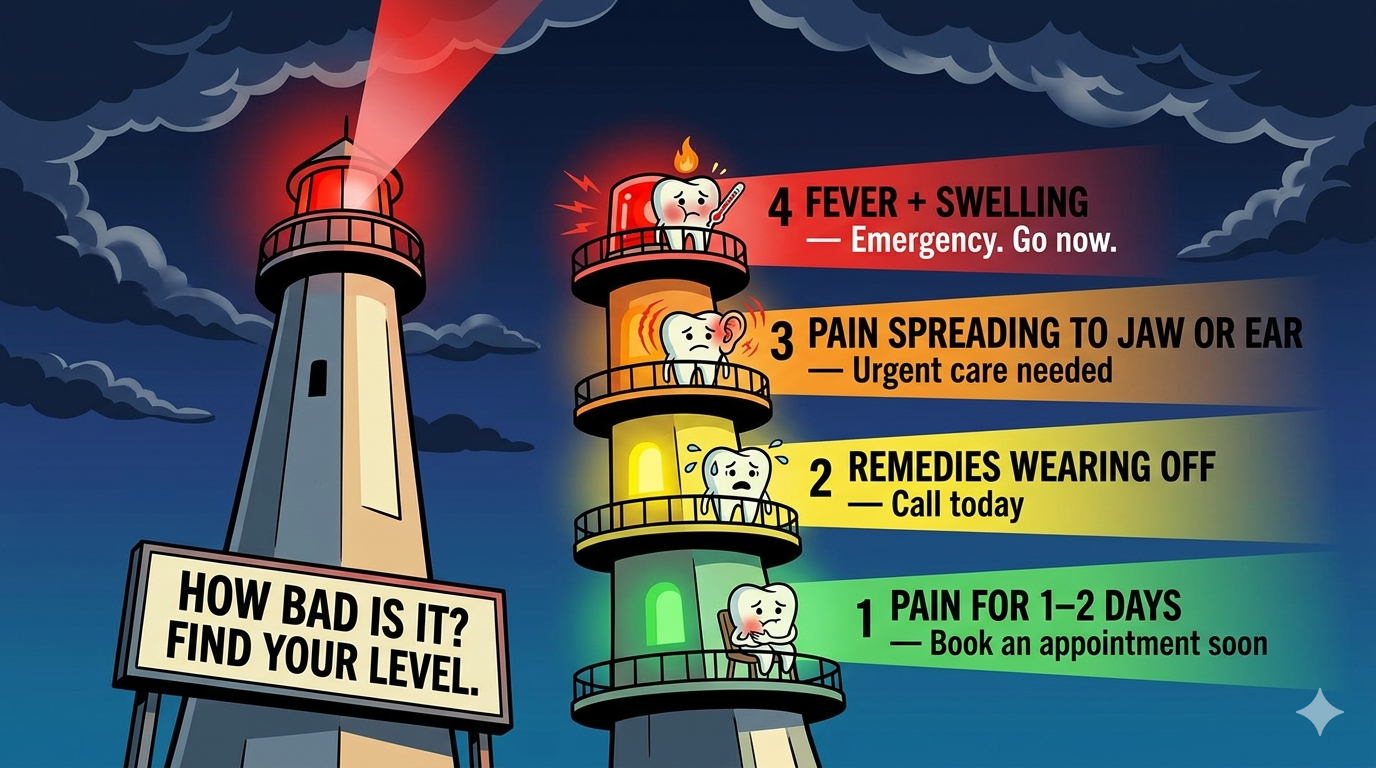
When the Pain Feels Unbearable Know These Signals
Home remedies are a bridge not a destination. These signals tell you the bridge has run out and professional care cannot wait:
| Signal |
What It Likely Means |
Action Needed |
| Pain lasts beyond 48 hours despite remedies |
Nerve damage or infection home remedies cannot resolve this |
Book dental appointment today |
| Remedies work for less time with each application |
Inflammation or infection is escalating faster than relief |
Urgent dental care same day if possible |
| Throbbing spreads to jaw, ear, or neck |
Infection spreading beyond the tooth into surrounding tissue |
Emergency seek care immediately |
| Fever develops alongside tooth pain |
Systemic infection can become a medical emergency |
Emergency dental or A&E if dental unavailable |
| Facial swelling appears on the affected side |
Abscess with significant infection may need oral surgery |
Same-day emergency dental care |
| Difficulty swallowing or breathing |
Infection spreading to airway life-threatening |
Call emergency services immediately |
| Pain completely disappears after severe throbbing |
Possible nerve death silent infection continues |
Book dental appointment within days |
⚠️
If you notice facial swelling, fever, or difficulty swallowing alongside tooth pain, do not wait for a routine appointment. These are signs of dental infection spreading beyond the tooth a condition that can become a medical emergency within hours. Book an emergency dental appointment or go to your nearest emergency department.
Why the Pain Keeps Coming Back The Truth About Temporary Relief
Every remedy in this guide works on the symptom the pain signal not the cause. Clove oil numbs the nerve ending but does not remove the decay that is exposing it. Ibuprofen reduces inflammation but does not repair the crack that is generating it. Saltwater cleans the area but does not drain an abscess or restore lost enamel.
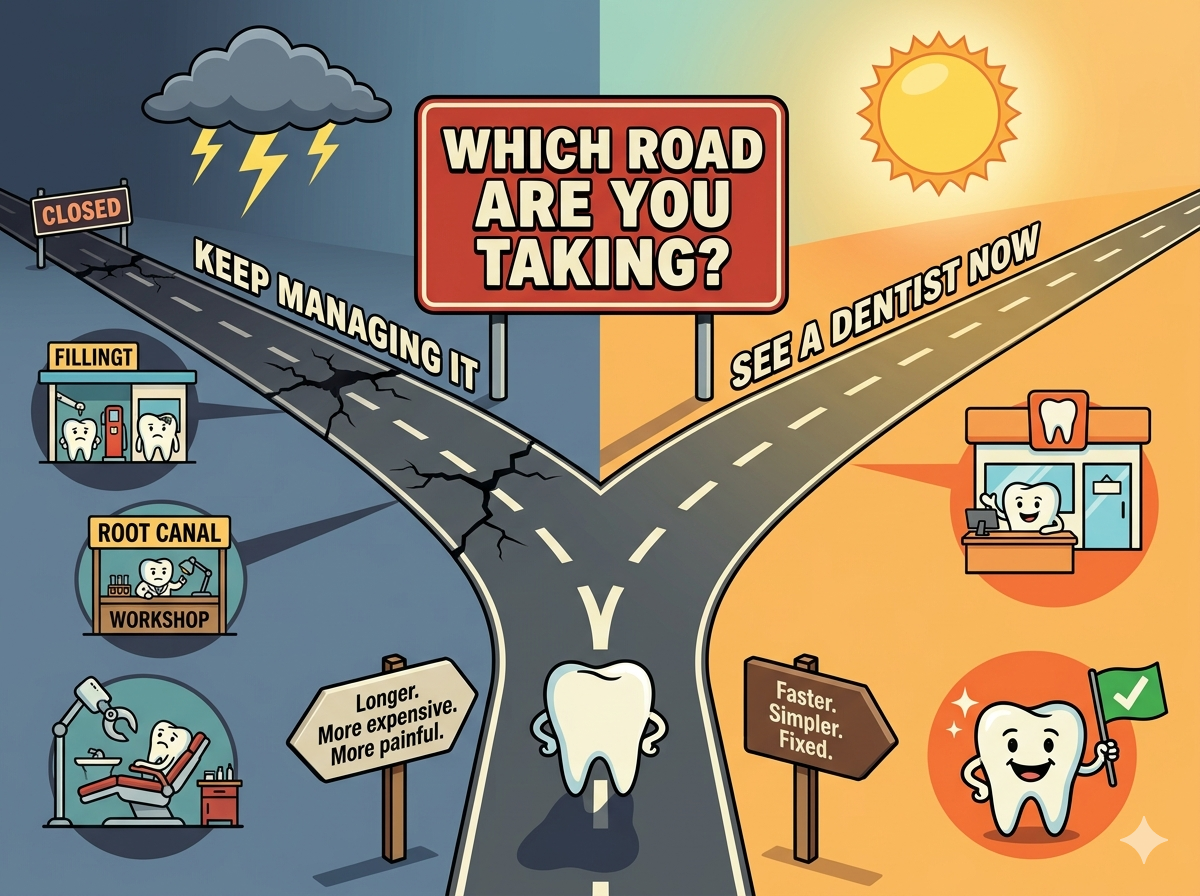
This is not a failure of the remedies it is simply the limit of what any home treatment can achieve for tooth nerve pain. The nerve is hurting because it is damaged, infected, or exposed in a way that only dental intervention can resolve. The longer the underlying cause is left untreated, the more the nerve deteriorates and the more complex the treatment required. What is a filling today becomes a root canal next month, and a root canal next month becomes an extraction the month after.
The goal of every remedy in this guide is to get you to a dentist comfortably not to replace the appointment. When you are ready to understand exactly what is causing your pain and get a permanent solution, you can explore the full range of dental treatments available and find the right path forward.
Frequently Asked Questions
Can you actually stop tooth nerve pain in 3 seconds?
No despite what you may have seen online, there is no remedy that eliminates tooth nerve pain in 3 seconds. Benzocaine gel is the fastest-acting option and begins working in 1–3 minutes. True nerve pain relief requires reducing inflammation or blocking the nerve signal, both of which take time. Any claim of a 3-second cure refers to a momentary distraction technique, not actual pain relief.
Is clove oil safe to use at home?
Yes, when used correctly. Always dilute pure clove oil with a carrier oil before applying undiluted clove oil can cause a chemical burn on soft tissue. Do not swallow it. Avoid use in children under 2, and consult a doctor before using during pregnancy. It is one of the few home remedies with genuine clinical backing
eugenol as a dental analgesic has been studied and used in dentistry for over a century.
How do I know if my tooth nerve pain is an emergency?
Treat it as an emergency if you have any of the following alongside tooth pain: facial swelling, fever, throbbing that spreads to the jaw or neck, difficulty swallowing, or a bad taste in the mouth suggesting abscess drainage. If the pain is sharp and localised with no other symptoms, it is urgent but not an emergency book a same-day or next-day appointment.
Why does tooth nerve pain get worse at night?
Two reasons. First, when you lie down, blood pressure in the head increases slightly, which intensifies throbbing in inflamed tissue around the tooth nerve. Second, the absence of daytime distractions makes you more aware of the pain signal. Sleeping with your head slightly elevated on an extra pillow can reduce the blood pressure effect and make night pain more manageable.
Can ibuprofen and paracetamol be taken together for tooth pain?
Yes and this combination is more effective than either alone because they work through different mechanisms. Ibuprofen reduces inflammation; paracetamol (acetaminophen) reduces the pain signal itself. They can be taken together or alternated every few hours. Always follow the
ibuprofen and acetaminophen dosage guidelines and do not exceed the recommended daily dose of either medication.
What if the pain suddenly stops completely is that good news?
Not necessarily. If severe throbbing pain suddenly disappears without any treatment, it can mean the nerve has died. The pain stops because the nerve is no longer alive to transmit the signal but the underlying infection does not stop. It continues silently, spreading to surrounding bone and tissue. A sudden complete cessation of previously severe pain warrants a dental appointment within a few days, not a sigh of relief.
The Bottom Line Relief Now, Solution Soon
Tooth nerve pain is your body signalling a structural problem that it cannot fix on its own. The remedies in this guide benzocaine gel, clove oil, cold compress, ibuprofen, saltwater rinse, and peppermint tea bag are all genuinely effective at reducing pain to manageable levels while you arrange care. For maximum effect, use the combination of topical numbing, cold compress, and oral anti-inflammatory simultaneously.
But the most important thing to understand is that pain relief is not the same as problem solved. A nerve that hurts today will hurt worse next week if the cause is left untreated. The sooner a dentist identifies what is actually happening, the more conservative and less costly the solution will be. When you are ready to stop managing the pain and start resolving it, make an appointment with our team for a thorough assessment and a clear treatment plan.
Stop Managing the Pain.
Start Fixing It.
Talpa Dental Steinfort & Limpertsberg, Luxembourg.