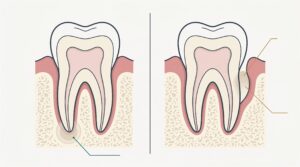



The short answer: no, a cracked tooth cannot heal itself, because enamel and dentin are non-living tissues with no blood supply to regenerate. But that doesn’t mean every crack is an emergency, and it doesn’t mean your options are limited to “wait” or “extraction.” This guide walks through why teeth can’t self-repair, how to tell how serious your crack is, what you can safely do while you wait for an appointment, and what treatment actually looks like.
Why a Cracked Tooth Can’t Heal Like a Broken Bone
Bone is living tissue. It has blood vessels, specialised cells (osteoblasts), and an active repair process that can knit a fracture back together over weeks. Tooth enamel is different: it’s the hardest substance in the human body, but it’s not alive. Once it cracks, there’s no cellular mechanism to fuse it back together. The dentin layer underneath is slightly more responsive but still can’t repair a structural fracture on its own.
The real risk isn’t the crack itself it’s what the crack lets in. A fracture creates a direct pathway for bacteria to reach the pulp (the nerve and blood vessel bundle at the tooth’s core). Left alone, that can lead to pulp inflammation, infection, and eventually an abscess that spreads to the surrounding bone and gum tissue.
The 5 Types of Tooth Cracks (And Which Ones Can Be Saved)
Not all cracks carry the same risk. Dentists classify them by depth and direction, and that classification is what determines whether a tooth can be saved.
| Crack Type | Description | Can It Be Saved? | Typical Treatment |
|---|---|---|---|
| Craze lines | Tiny surface cracks in enamel only | Yes | Monitoring, sometimes bonding |
| Fractured cusp | A piece of the chewing surface breaks off, often around an old filling | Yes | Filling or crown |
| Cracked tooth | Vertical crack from the chewing surface downward, tooth still in one piece | Often | Root canal treatment + crown |
| Split tooth | Crack has fully separated the tooth into two segments | Rarely as a whole | Partial preservation or extraction |
| Vertical root fracture | Crack begins at the root and works upward, often hidden by the gum | Rarely | Extraction, sometimes endodontic surgery |
Signs Your Tooth Might Be Cracked
Cracks don’t always announce themselves. Some produce no symptoms at all until they’re already advanced, which is why routine checkups matter as much as reacting to pain. Watch for:
- Sharp pain when biting down, especially right as you release pressure
- Sensitivity to hot, cold, or sweet foods that fades quickly
- Pain that comes and goes rather than staying constant
- Swelling or tenderness in the gum next to one specific tooth
- A visible line or notch you can feel with your tongue but can’t quite see
If a dentist takes an X-ray and finds nothing, that doesn’t rule out a crack many fractures run parallel to the X-ray beam and simply don’t show up. A clinical exam, bite test, and sometimes 2D/3D dental imaging give a far more reliable picture.
How Long Can You Wait Before Seeing a Dentist?
As a general rule: if you suspect a crack, aim to be seen within 24–48 hours, especially if there’s pain on biting or temperature sensitivity. A crack that’s confined to the enamel can often wait for a routine appointment. A crack that’s reached the pulp is a different story every day of delay gives bacteria more time to establish an infection, and once the crack propagates below the gum line, extraction may become the only option.
The practical pattern dentists see again and again: a tooth that would have needed a simple filling in week one needs a root canal by month one, and needs extraction by month three. Early treatment isn’t just more comfortable it’s usually cheaper and preserves more of your natural tooth.
What You Can (and Can’t) Do While You Wait
None of the following will heal the crack. They’re just ways to keep things stable until you’re seen.
- Rinse gently with warm salt water after eating to reduce bacteria around the area.
- Chew on the opposite side of your mouth.
- Avoid very hot, very cold, or very sweet foods and drinks, which can trigger sharp pain.
- Take an over-the-counter pain reliever as directed if needed.
- Avoid biting directly on hard foods (nuts, ice, hard candy) even on the “good” side, since clenching can still stress the cracked tooth.
What not to do: don’t apply clove oil, whisky, aspirin, or numbing gel directly to the tooth or gum expecting it to “fix” anything these mask sensation temporarily at best and can irritate soft tissue at worst. And don’t skip the appointment because the pain settles down; intermittent pain is a classic pattern for a worsening crack, not a sign it’s resolving.
Myth-Busting: “Natural” Ways People Think Heal a Cracked Tooth
A lot of search results promise natural healing methods. Here’s where the confusion comes from, and why they don’t apply to a structural crack:
Remineralizing toothpaste and fluoride genuinely help rebuild microscopic mineral loss on the enamel surface (early decay), which is a completely different process from mending a fracture line. They cannot close a crack.
Oil pulling and clove oil may have a mild antibacterial or numbing effect, but there is no mechanism by which either can repair or reduce a structural crack in enamel or dentin.
Calcium and vitamin D supplements support bone and tooth mineral density over the long term (useful for prevention), but they don’t reach an existing crack and rebuild it enamel doesn’t remodel itself the way bone does.
The pattern across all three: they’re either prevention tools or symptom management, not treatment for a crack that already exists.
How Talpadent Diagnoses a Cracked Tooth
Because cracks are notoriously hard to see on a standard X-ray, diagnosis usually combines a few methods: a visual exam under magnification, a bite test to isolate which tooth and cusp is involved, checking the gum for localized inflammation, and imaging. Talpadent uses 2D/3D Dental Radiology to get a clearer view of the crack’s depth and proximity to the pulp and root important for deciding between a filling, a crown, or root canal treatment.
Treatment Options If Your Tooth Is Cracked
Bonding or adhesive fillings for craze lines or minor cusp fractures that don’t involve the pulp, a tooth-coloured composite restores shape and protects the area.
Dental crowns for cracks that involve a larger portion of the chewing surface, a crown caps the tooth and prevents the crack from spreading further under normal biting force.
Root canal treatment if the crack has reached the pulp and caused inflammation or infection, the damaged pulp tissue is removed before the tooth is sealed and crowned. This is usually what saves a tooth that would otherwise be lost.
Extraction and replacement when a crack has split the tooth or extends below the gum line into the root, extraction is often the only safe option, typically followed by discussion of a dental implant to preserve jawbone structure and function.
Periodontal care if a crack has led to localized gum infection or bone involvement around the tooth, additional periodontal treatment may be needed alongside restorative work.
What About Children’s Teeth?
Children crack teeth too, most often front teeth from falls, sports, or biting hard objects. The approach differs depending on whether it’s a baby tooth or a permanent one a cracked baby tooth sometimes just needs monitoring since it will eventually be replaced, while a cracked permanent tooth in a child is treated with the same urgency as in an adult, often with extra care taken to preserve the nerve since a child’s tooth is still developing. If your child has cracked or chipped a tooth, a pediatric-focused evaluation matters.
Cost and Insurance Considerations in Luxembourg
In Luxembourg, the CNS (Caisse Nationale de Santé) partially reimburses most restorative dental care: routine treatments are generally covered at a high percentage of the conventional tariff, while procedures like root canal treatment and crowns are typically reimbursed around 80%, sometimes rising if you’ve had regular annual checkups. Crown and bridge work usually requires a cost estimate submitted for prior approval. Because reimbursement rates and conditions can change, it’s worth confirming your specific coverage with the CNS or asking the clinic to check before treatment begins.
Frequently Asked Questions
No. Pain fading doesn't mean the crack has healed — it often means the nerve is dying, which can feel like relief before the infection progresses. Any tooth that has cracked should still be evaluated.
Not always. If the crack hasn't reached the pulp, a filling or crown may be enough. A root canal becomes necessary once the pulp is inflamed or infected.
The crack typically worsens over time. Bacteria can infect the pulp, leading to an abscess that may spread to the jawbone, and the tooth's chances of being saved decrease the longer treatment is delayed.
No, the same biological limits apply. However, if it's a baby tooth close to naturally falling out, a dentist may choose to monitor rather than treat aggressively.
Not necessarily an emergency, but it should still be checked soon. Some of the most serious crack types (like vertical root fractures) cause little to no pain until they're advanced.
If You Suspect a Cracked Tooth
Waiting won’t make a crack heal but seeing a dentist early gives you the best chance of keeping your natural tooth, with simpler and less costly treatment. If you’re noticing sensitivity, pain when biting, or you know you’ve cracked a tooth, book a consultation at Talpadent’s Steinfort or Limpertsberg clinic.

Dr. Talpa is a licensed dentist with 12 years of clinical experience and owner of Advanced Smile Dental Care. Dedicated to making dental health information accessible, Dr. Talpa writes to help readers make informed decisions about their oral care. With a background in general and cosmetic dentistry, Dr. Talpa is passionate about translating complex dental topics into practical advice. When not treating patients, Dr. Talpa enjoys staying current with the latest advances in dental science and technology.